GMAT Low-Thrust Orbital-Transfer Study
A NASA GMAT R2026a study of a solar-electric transfer from an elliptical Earth orbit toward geosynchronous altitude, including eclipse interruptions, propellant use, numerical convergence, and sensitivity cases.
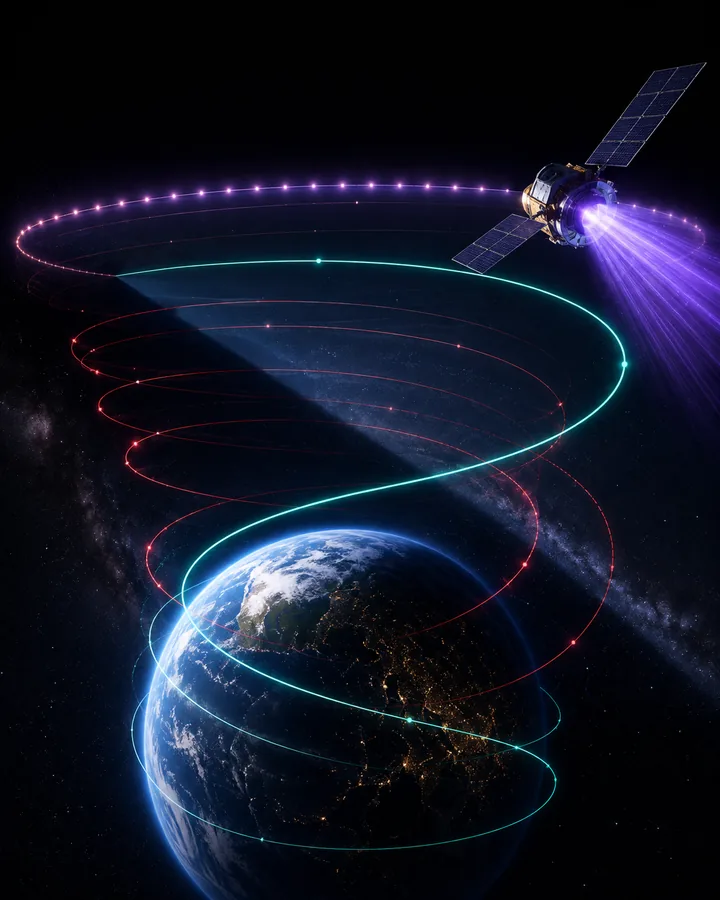
Project definition
Problem statement
Low-thrust electric propulsion can provide high propellant efficiency, but the transfer lasts much longer than a chemical manoeuvre and the thrust available changes with power, efficiency, specific impulse, and eclipse interruptions.
The engineering problem is to model these effects consistently, quantify their influence on transfer time and xenon use, and separate physical trends from integration-step error.
Project objectives
- Build an official GMAT R2026a mission from an elliptical Earth orbit to geosynchronous semi-major axis.
- Model solar-electric thrust, propellant depletion, eclipse interruptions, and the changing spacecraft state.
- Compare thruster power, efficiency, specific impulse, initial mass, and solar-array degradation cases.
- Check 120, 300, and 600 second integration steps and retain a justified baseline step.
- Compare a constant-mass point-mass analytical benchmark with GMAT.
- Measure transfer duration, xenon use, terminal orbit, eclipse time, and numerical sensitivity.
Project structure
Project components
Mission definition
Stores the initial orbit, spacecraft, propellant tank, electric thruster, power system, force model, propagator, eclipse logic, and stop condition.
Mission generator
Creates 26 reviewable GMAT scripts from the recorded study matrix.
GMAT runner
Runs each case in official GMAT R2026a and retains the numerical report and execution log.
Result parser
Reads the GMAT records and calculates transfer duration, final mass, xenon use, terminal orbit, eclipse fraction, and phase consistency.
Benchmark and convergence
Compares GMAT with the analytical constant-mass case and measures integration-step differences.
Evidence builder
Exports full-precision results, artifact hashes, row counts, summaries, and 13 labelled project figures.
Methodology
Project workflow
- 01Select a mission
Choose the baseline or a prepared power, efficiency, specific-impulse, mass, degradation, eclipse, benchmark, or integration-step case.
- 02Generate the GMAT script
Write the complete spacecraft, propulsion, propagation, reporting, and mission-sequence definition.
- 03Run GMAT
Execute the mission in official GMAT R2026a and retain the state and event records.
- 04Analyse the evidence
Calculate the transfer metrics and verify that thrust and eclipse phases are internally consistent.
- 05Compare the study
Use the completed mission matrix, benchmark, and convergence cases to explain the engineering tradeoffs and limitations.
Demonstration scenario
The student runs the baseline mission and obtains a 133.22-day transfer using 199.34 kg of xenon, with 12.64 percent of elapsed time in eclipse. The point-mass benchmark differs by only 0.000237 percent, while the integration-step study shows why the 600 second case is too coarse for the retained baseline.
Engineering
Tools and method
- Tools
- The project uses NASA GMAT R2026a, Python, NumPy, pandas, Matplotlib, Jupyter for subject analysis, simulation, and results.
- Orbit model
- GMAT Earth-centred propagation with gravity, lunar and solar perturbations, solar radiation pressure, and eclipse calculation.
- Propulsion model
- A finite-burn electric-thruster model with a chemical tank used as the consumable xenon-mass store and explicit power-dependent thrust.
- Experiment
- Twenty-six completed missions covering the baseline, analytical benchmark, numerical convergence, and propulsion and power sensitivities.
- Evidence
- Full-precision summaries, artifact hashes and row counts, 13 figures, and the generated GMAT mission scripts.
- Verification
- Thirty-six automated tests, analytical comparison, integration-step study, repository validation, dependency audit, and Linux container test.
Testing
Evaluation
Evaluation measures
- Transfer duration and xenon consumption
- Terminal semi-major-axis error, eccentricity, and inclination
- Elapsed time in eclipse and thrust interruption behaviour
- Sensitivity to power, efficiency, specific impulse, initial mass, and power degradation
- Agreement with the constant-mass analytical benchmark
- Integration-step sensitivity and retained numerical evidence
Project boundaries
- The terminal condition targets geosynchronous semi-major axis and does not complete circularisation or inclination removal.
- The propulsion and power models use declared engineering assumptions and are not a qualified flight system model.
- The mission excludes launch dispersions, guidance errors, detailed thermal behaviour, radiation degradation, station keeping, collision avoidance, and flight operations.
- A real mission requires calibrated hardware data, navigation and guidance design, uncertainty analysis, operations planning, safety review, and independent verification.
Included
- 01Complete Python source code and 26 generated GMAT mission scripts
- 02Baseline, benchmark, convergence, power, propulsion, orbit, and eclipse cases
- 03Full-precision CSV and JSON results with 13 generated project figures
- 0436 automated tests with 99.32 percent branch-aware coverage
- 05Complete project files and analysis material in a private GitHub repository
- 0670-page project documentation in PDF and editable Word formats
- 0710-page setup and usage guide in PDF and editable Word formats
- 0855 annotated references and four sourced NASA literature images
Project record
No information is collected on this page.
- Permanent project ID
- GP-AE-17MB7U3
- Catalogued
- 21 Aug 2026
- Completed
- 26 Aug 2026
- Verified
- 26 Aug 2026
- Demonstration
- Included in repository
Handover
After purchase
- 01Payment is confirmed
The project is marked unavailable and cannot be purchased again.
- 02Repository access is granted
The buyer's submitted GitHub account receives access to the private repository.
- 03The purchase record is delivered
The certification sheet is prepared from the reviewed buyer details and sent privately by email.