Hydrogen-Aircraft Certification Hazard and Safety-Assurance Framework
Study how hydrogen fuel state, aircraft installation, ventilation and response delays change the evidence needed to support a safety claim.
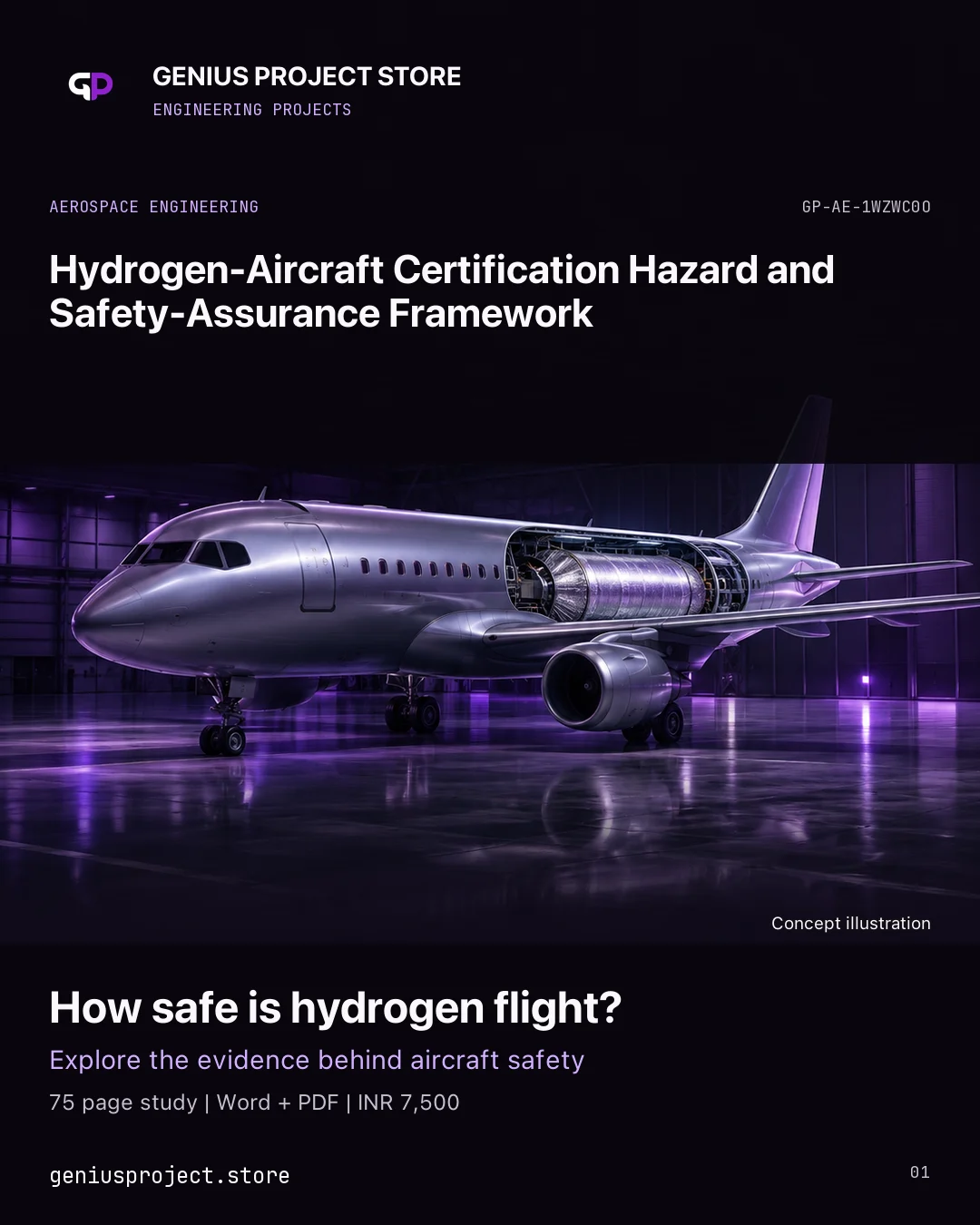
Project definition
Problem statement
Evidence from an outdoor gaseous-hydrogen study cannot automatically establish the safety of an enclosed liquid-hydrogen aircraft installation.
This study connects those evidence boundaries with detection, isolation, ventilation, shared power and tank-integration questions.
Project objectives
- Identify assumptions that must be reconsidered when transferring published hydrogen evidence to a different aircraft installation.
- Recalculate selected published gas-fraction and stopping-distance examples without concealing unresolved discrepancies.
- Examine compartment-average gas accumulation under prescribed response delays and loss-of-control scenarios.
- Separate model verification, literature evidence and the physical validation still needed for an aircraft safety claim.
Project structure
Project components
Literature review
Connects 35 sources on hydrogen aviation, hazard analysis, release behaviour, crash integration and model credibility.
Published-data checks
Recalculates selected reported values and distinguishes measurements, estimates, instrument limits and model outputs.
Compartment model
Solves a stated gas balance exactly for hypothetical warmed releases, ventilation and response timing.
Assurance framework
Maps twelve open claims to assumptions, supporting sources and missing validation evidence.
Methodology
Project workflow
- 01Read the boundary
Start with the aircraft installation, fuel state and intended claim.
- 02Trace the sources
Follow the annotated references and source-data notes.
- 03Reproduce the calculations
Run all three analysis stages and compare the retained outputs.
- 04Explore a change
Modify one declared input and explain how it affects the gas balance or evidence requirements.
- 05Present the findings
Use the editable slides to explain results, limitations and further work.
Demonstration scenario
Compare the same hypothetical release with normal response and a shared-power-loss scenario. Explain why a verified calculation can reveal a concern without proving the safety or failure probability of a real aircraft.
Engineering
Tools and method
- Tools
- The project uses Python 3.12, Matplotlib for subject analysis, simulation, and results.
- Analysis
- Python runs the numerical study without third-party runtime dependencies; Matplotlib is used for figures.
- Verification
- 160 automated tests and an offline Docker reproduction check the analytical solution, source calculations, assurance links and presentation values.
- Documentation
- The report includes theory, literature review, methodology, results, discussion, conclusions, further work and labelled figures and tables.
Testing
Evaluation
Evaluation measures
- Gas mass-balance residual and agreement with analytical limiting cases
- Peak compartment-average hydrogen fraction and source shutoff timing
- Time above comparison fractions, with finite-horizon censoring identified
- Agreement and unresolved differences in selected published arithmetic
- Traceability of assurance claims and remaining validation gaps
Project boundaries
- This is a desk-based study, not a certified aircraft design or safety case.
- The model assumes a prescribed warmed gaseous source, perfect mixing and an open displacement outlet. Zero clean-air ventilation does not mean a sealed enclosure.
- It does not simulate cryogenic spills, pressure peaking, flames, explosions or crashes.
- One-percent and four-percent fractions are comparison references, not certification limits. Compartment means are not local maxima.
- All twelve aircraft-assurance claims remain open. No experimental or aircraft validation is claimed.
Included
- 0175-page project report in PDF and editable Word formats
- 02Nine-page setup and usage guide in PDF and editable Word formats
- 0320-slide editable presentation with source notes
- 0435 annotated references and an attributed literature image
- 05729 hypothetical factorial cases, 108 fault cases and 27 separate baseline cases
- 06Published-data arithmetic checks and twelve open assurance claims
- 07Complete source code, retained results and 160 automated tests
Project record
No information is collected on this page.
- Permanent project ID
- GP-AE-1WZWC0O
- Catalogued
- 21 Aug 2026
- Completed
- 05 Sept 2026
- Verified
- 05 Sept 2026
- Demonstration
- Included in repository
Handover
After purchase
- 01Payment is confirmed
The project is marked unavailable and cannot be purchased again.
- 02Repository access is granted
The buyer's submitted GitHub account receives access to the private repository.
- 03The purchase record is delivered
The certification sheet is prepared from the reviewed buyer details and sent privately by email.