OpenFOAM Propellant Slosh Dynamics
An OpenFOAM study of free-surface motion, fill level, impulse strength, liquid viscosity, porous baffle resistance, mesh resolution, and lateral tank force.
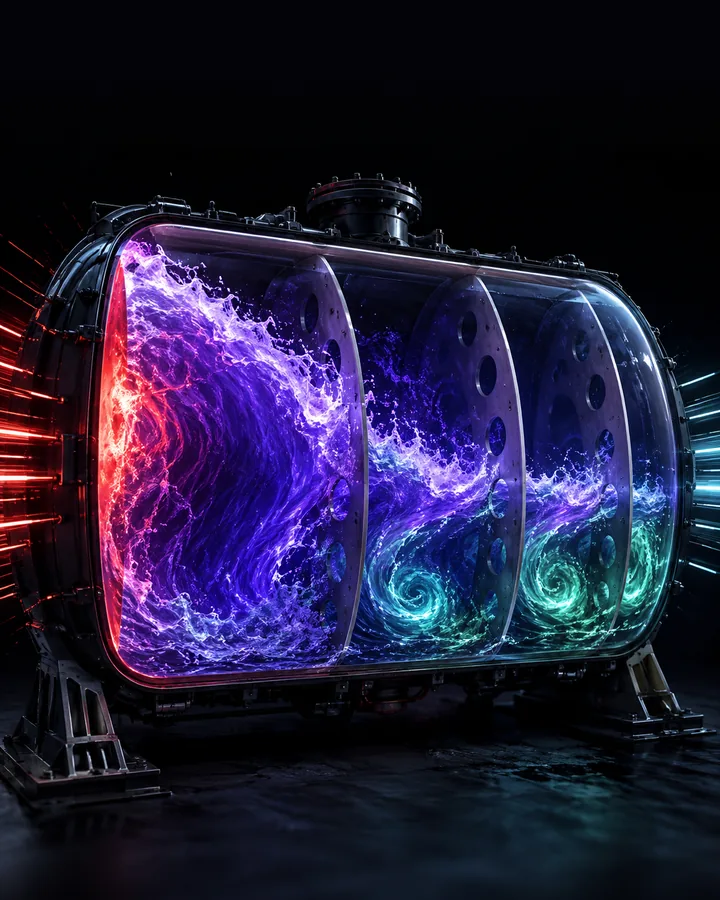
Project definition
Problem statement
Liquid motion inside a partly filled tank changes the force transmitted to the vehicle. Fill level, manoeuvre strength, viscosity, baffles, mesh resolution, and time-step control can all affect the calculated response.
The engineering problem is to compare these effects through one controlled multiphase CFD study and separate physical findings from numerical sensitivity.
Project objectives
- Build a two-phase rectangular tank model with a water and air surrogate.
- Measure free-surface response, dominant frequency, damping, lateral force, and liquid-volume conservation.
- Compare 30, 50, and 70 percent fill levels.
- Compare two impulse strengths, two liquid viscosities, and two porous baffle resistance levels.
- Check mesh and Courant-number sensitivity.
- Compare the baseline CFD frequency with linear slosh theory.
Project structure
Project components
Tank case
Defines the two-phase domain, initial fill, gravity, surface tension, mesh, boundaries, and transient solver controls.
Porous baffle
Creates a central internal screen with controlled viscous and inertial resistance.
Study runner
Creates and runs the twelve prepared OpenFOAM cases from one recorded scenario table.
Result analysis
Reads the OpenFOAM function outputs and calculates height, frequency, damping, force, impulse, and volume metrics.
Evidence export
Writes complete CSV and JSON records and produces ten labelled result figures.
Verification
Checks parsers, equations, configuration changes, scenario coverage, and release thresholds.
Methodology
Project workflow
- 01Prepare the case
Build the mesh, initialise the liquid region, and create the internal porous screen where required.
- 02Run the transient model
Solve free decay for eight seconds while recording interface height, liquid volume, and wall force.
- 03Analyse each case
Calculate response amplitude, dominant frequency, damping, peak lateral force, and absolute force impulse.
- 04Check numerical quality
Compare mesh and Courant cases and confirm liquid-volume conservation.
- 05Compare the study
Evaluate fill, impulse, viscosity, baffle, and numerical effects with common metrics.
Demonstration scenario
The student compares the smooth tank with mild and strong porous screens. The strong screen reduces absolute lateral-force impulse by about 49.35 percent while the baseline frequency remains within 0.81 percent of linear theory. The discussion then separates damping benefits from numerical and modelling limits.
Engineering
Tools and method
- Tools
- The project uses OpenFOAM 13, Python, NumPy, SciPy, pandas, Matplotlib, Jupyter for subject analysis, simulation, and results.
- CFD model
- OpenFOAM 13 incompressibleVoF with a volume-of-fluid free surface, gravity, and surface tension.
- Experiment
- Twelve completed cases covering physical parameters, baffle resistance, and numerical sensitivity.
- Evidence
- Native function-object records, full-precision CSV and JSON results, and ten figures generated from those records.
- Verification
- Automated tests plus theoretical frequency, mesh, time-step, and volume-conservation checks.
Testing
Evaluation
Evaluation measures
- Peak free-surface response and dominant slosh frequency
- Damping ratio where a stable decay envelope can be resolved
- Peak lateral force and absolute force impulse
- Frequency agreement with linear slosh theory
- Liquid-volume conservation
- Mesh and Courant-number sensitivity
Project boundaries
- The tank is a two-dimensional rectangular water and air surrogate study under Earth gravity.
- The porous screen uses a pressure-loss model and is not a resolved perforated geometry.
- The model does not represent a specific propellant, flight manoeuvre, microgravity mission, thermal condition, or certified vehicle tank.
- A flight design requires matched fluid data, tank geometry, acceleration history, structural coupling, thermal effects, experiments, and safety evidence.
Included
- 01OpenFOAM tank case and twelve prepared study cases
- 02Free-surface height, force, frequency, damping, and liquid-volume results
- 03CSV and JSON results with ten generated figures
- 0429 automated tests with 98 percent coverage
- 05Complete project files and analysis material in a private GitHub repository
- 0672-page project documentation in PDF and editable Word formats
- 0721-page setup and usage guide in PDF and editable Word formats
- 0845 annotated references and one sourced literature image
Project record
No information is collected on this page.
- Permanent project ID
- GP-AE-1KCPSF1
- Catalogued
- 21 Aug 2026
- Completed
- 25 Aug 2026
- Verified
- 25 Aug 2026
- Demonstration
- Included in repository
Handover
After purchase
- 01Payment is confirmed
The project is marked unavailable and cannot be purchased again.
- 02Repository access is granted
The buyer's submitted GitHub account receives access to the private repository.
- 03The purchase record is delivered
The certification sheet is prepared from the reviewed buyer details and sent privately by email.