OpenMDAO hybrid-electric aircraft sizing
An OpenMDAO study of a 40-passenger hybrid-electric regional aircraft, including mass, aerodynamics, mission energy, fuel, battery sizing, thermal management, and field performance.
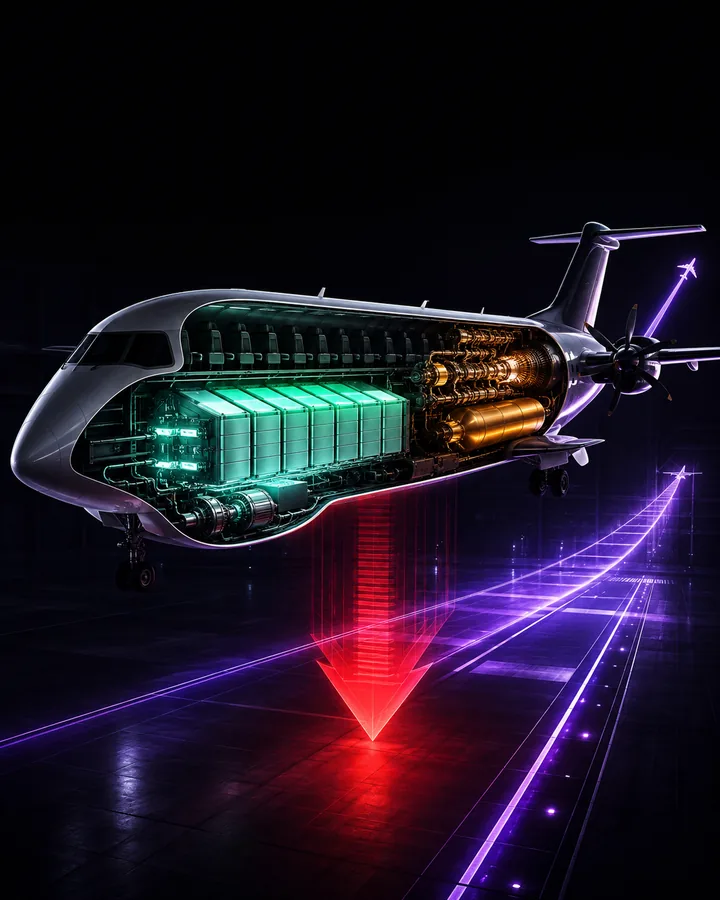
Project definition
Problem statement
Hybrid-electric propulsion can reduce the thermal share of mission energy, but batteries, motors, inverters, cooling, and the resulting aircraft mass can remove that benefit.
The engineering problem is to size the aircraft disciplines together and identify how battery technology, electric fraction, range, reserve, and field constraints change the feasible design.
Project objectives
- Build coupled aerodynamic, mission-energy, fuel, battery, powertrain, cooling, airframe, and field-performance models.
- Close the aircraft mass and minimize takeoff mass under stall, takeoff, climb, and battery-fraction constraints.
- Compare 10, 20, and 30 percent electric propulsion at 300, 450, and 650 Wh/kg pack specific energy.
- Test short-range and long-range hybrid missions.
- Compare direct fuel CO2 with electricity-related mission CO2.
Project structure
Project components
Aerodynamics
Calculates lift-to-drag ratio, wing loading, and stall speed from takeoff mass, wing area, and aspect ratio.
Mission energy
Calculates cruise, climb, reserve, hotel load, installed power, fuel energy, electric energy, and mission time.
Hybrid powertrain
Sizes the battery by energy and power and estimates motor, inverter, cable, engine, heat, and cooling mass.
Mass closure
Balances payload, airframe, powertrain, cooling, operational items, fuel, and battery mass.
Field performance
Checks stall speed, takeoff distance, climb gradient, power loading, and battery mass fraction.
Experiment
Runs twelve prepared cases and writes complete CSV, JSON, and figure evidence.
Methodology
Project workflow
- 01Select a case
Choose the conventional aircraft or a prepared hybrid technology and mission case.
- 02Assemble the model
OpenMDAO connects aerodynamics, mission energy, powertrain, mass, and field-performance components.
- 03Optimize the aircraft
SLSQP minimizes takeoff mass while closing mass and enforcing the prepared constraints.
- 04Record the result
The completed case stores all inputs, optimized values, feasibility checks, battery sizing driver, and carbon metrics.
- 05Compare the study
The experiment compares battery levels, electric fractions, mission range, mass, fuel, field performance, and electricity carbon intensity.
Demonstration scenario
The student compares the conventional baseline with 20 percent electric propulsion at 300, 450, and 650 Wh/kg. The results show how improved battery technology reduces the aircraft mass penalty and why electricity carbon intensity must be reported separately from onboard fuel.
Engineering
Tools and method
- Tools
- The project uses Python, OpenMDAO, NumPy, SciPy, Matplotlib, Jupyter for subject analysis, simulation, and results.
- OpenMDAO model
- Explicit aerospace components with shared SI-unit variables, finite-difference derivatives, design bounds, objective, and constraints.
- Optimization
- SciPy SLSQP through OpenMDAO with scaled variables, strict tolerance, and a recorded success state.
- Evidence
- Full-precision CSV and JSON results plus eight figures generated from the same twelve-case record.
- Verification
- Automated tests for input boundaries, physical behavior, mass closure, constraints, scenarios, commands, exports, and figures.
Testing
Evaluation
Evaluation measures
- Optimized takeoff mass and mass-closure residual
- Mission fuel and battery mass
- Energy-limited or power-limited battery sizing
- Stall speed, takeoff distance, and climb gradient
- Direct fuel CO2 and electricity-related mission CO2
- Sensitivity to electric fraction, battery specific energy, and mission range
Project boundaries
- This is a conceptual aircraft sizing and trade study.
- It is not a detailed geometry, CFD, structural, propeller, engine-cycle, battery-safety, certification, or flight-test model.
- The optimizer finds a local solution to the declared equations and bounds.
- A real aircraft programme requires calibrated component data, system safety, certification, manufacturing, and test evidence.
Included
- 01OpenMDAO aircraft sizing source code
- 02Conventional and hybrid-electric prepared cases
- 03CSV and JSON results with eight labelled figures
- 04Complete project files and analysis material in a private GitHub repository
- 0583-page project documentation in PDF and editable Word formats
- 0612-page setup and usage guide in PDF and editable Word formats
- 0742 annotated references
Project record
No information is collected on this page.
- Permanent project ID
- GP-AE-175UAZ5
- Catalogued
- 21 Aug 2026
- Completed
- 24 Aug 2026
- Verified
- 24 Aug 2026
- Demonstration
- Included in repository
Handover
After purchase
- 01Payment is confirmed
The project is marked unavailable and cannot be purchased again.
- 02Repository access is granted
The buyer's submitted GitHub account receives access to the private repository.
- 03The purchase record is delivered
The certification sheet is prepared from the reviewed buyer details and sent privately by email.