Turbojet Exhaust Emissions and Thrust Tradeoff
A controlled propulsion and environmental study comparing a round nozzle, chevron, and mixer ejector through gross thrust, plume temperature, dilution, NOx, CO, and atmospheric screening.
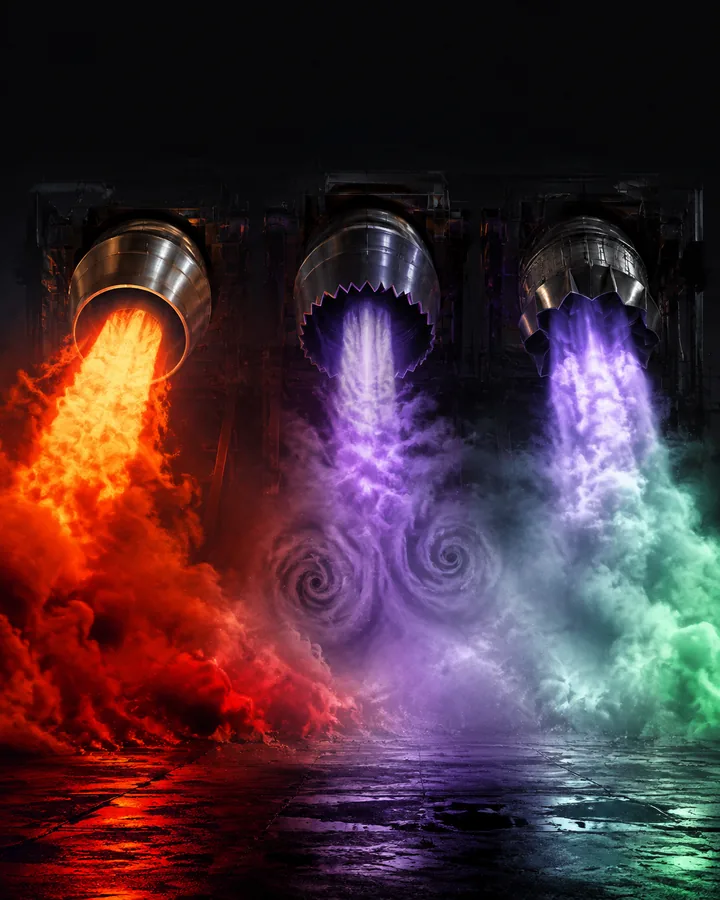
Project definition
Problem statement
An exhaust design can improve early plume mixing and lower centreline temperature while also reducing gross thrust. It can change where a conserved pollutant mass is distributed without reducing the mass produced by the combustor.
The engineering problem is to compare propulsion, plume, and ground-screening effects with common inputs and without confusing downstream mixing with an emissions-source reduction.
Project objectives
- Calculate one-dimensional nozzle exit state, effective area, and gross thrust for four operating modes.
- Compare a round nozzle, conceptual chevron, and conceptual mixer ejector.
- Calculate plume width, dilution, and centreline temperature over distance.
- Calculate NOx and CO source rates from fuel flow and emission indices.
- Screen ground-level concentration under four weather cases.
- Measure uncertainty and input sensitivity with a seeded experiment.
Project structure
Project components
Nozzle model
Calculates choking, exit pressure, exit temperature, velocity, effective area, and gross thrust.
Exhaust design model
Stores the thrust coefficient, mixing multiplier, spreading rate, initial plume width, and secondary-air assumption for each concept.
Plume model
Calculates plume width, dilution, and centreline temperature from the declared reduced-order relations.
Emissions model
Calculates NOx and CO source mass rates and preserves them across downstream exhaust concepts.
Ground screen
Compares centreline ground concentration over weather, wind, stability, and distance cases.
Uncertainty study
Runs 500 seeded samples per design and reports percentiles and rank sensitivity.
Methodology
Project workflow
- 01Load inputs
Read the operating points, exhaust assumptions, weather cases, and receptor distances.
- 02Calculate nozzle state
Determine choking, exit state, effective area, and gross thrust for each operating mode.
- 03Calculate plume behaviour
Apply the declared mixing assumptions to plume width, dilution, and temperature over distance.
- 04Screen emissions
Conserve the NOx and CO source mass and compare its ground-level distribution under each weather case.
- 05Measure uncertainty
Sample the declared uncertain inputs and retain response percentiles and sensitivity evidence.
- 06Review results
Compare thrust, temperature, dilution, source mass, concentration, and uncertainty without combining them into one unexplained score.
Demonstration scenario
The student compares the three exhaust concepts at takeoff. The chevron retains 99.3 percent of the round-nozzle gross thrust while lowering the predicted 10 m centreline temperature from 482.51 K to 451.74 K. The NOx source remains 6.0648 g/s for every design, showing the difference between source mass and downstream distribution.
Engineering
Tools and method
- Tools
- The project uses Python, NumPy, SciPy, pandas, Matplotlib, Jupyter for subject analysis, simulation, and results.
- Engineering package
- Typed Python records and separate nozzle, plume, dispersion, input, and experiment modules.
- Experiment
- A complete 336-case deterministic matrix and a 1,500-sample seeded uncertainty study.
- Evidence
- Full-precision CSV and JSON records with eight figures generated from the retained results.
- Verification
- Automated tests for physical limits, equations, validation, case counts, reproducibility, commands, and exports.
Testing
Evaluation
Evaluation measures
- Gross thrust and thrust retention by design and mode
- Plume centreline temperature and dilution over distance
- NOx and CO source mass rate by operating mode
- Ground-screening concentration by weather and distance
- p05, median, and p95 response values by design
- Spearman rank sensitivity for eight uncertain inputs
Project boundaries
- This is a controlled preliminary-design study with declared conceptual inputs.
- It is not a certified engine deck, geometry-resolved CFD model, measured plume, AEDT result, AERMOD result, or regulatory assessment.
- The ground screen omits buildings, terrain, chemistry, background concentration, aircraft motion, and time-varying meteorology.
- A physical design requires matched engine data, geometry, CFD, experiments, uncertainty, safety, and certification evidence.
Included
- 01Python source code and command-line tools
- 02Four operating modes and three exhaust concepts
- 03336 deterministic cases and 1,500 uncertainty samples
- 04CSV and JSON results with eight generated figures and an offline dashboard
- 05Complete project files and analysis material in a private GitHub repository
- 06100-page project documentation in PDF and editable Word formats
- 0720-page setup and usage guide in PDF and editable Word formats
- 0845 annotated references
Project record
No information is collected on this page.
- Permanent project ID
- GP-AE-1AK7YD0
- Catalogued
- 21 Aug 2026
- Completed
- 24 Aug 2026
- Verified
- 24 Aug 2026
- Demonstration
- Included in repository
Handover
After purchase
- 01Payment is confirmed
The project is marked unavailable and cannot be purchased again.
- 02Repository access is granted
The buyer's submitted GitHub account receives access to the private repository.
- 03The purchase record is delivered
The certification sheet is prepared from the reviewed buyer details and sent privately by email.