Bioreactor oxygen-transfer and scale-up model
A completed stirred-tank bioreactor study comparing oxygen transfer, mixing, power, heat release, fed-batch intensity, and productivity from 2 to 2,000 L.
Project definition
Problem statement
A bioreactor operating point that works at laboratory scale may not preserve oxygen transfer, mixing, heat removal, gas flow, and mechanical limits at pilot or production scale.
The engineering problem is to compare common scale-up rules under one declared biological model and show their competing effects instead of treating kLa as the only design target.
Project objectives
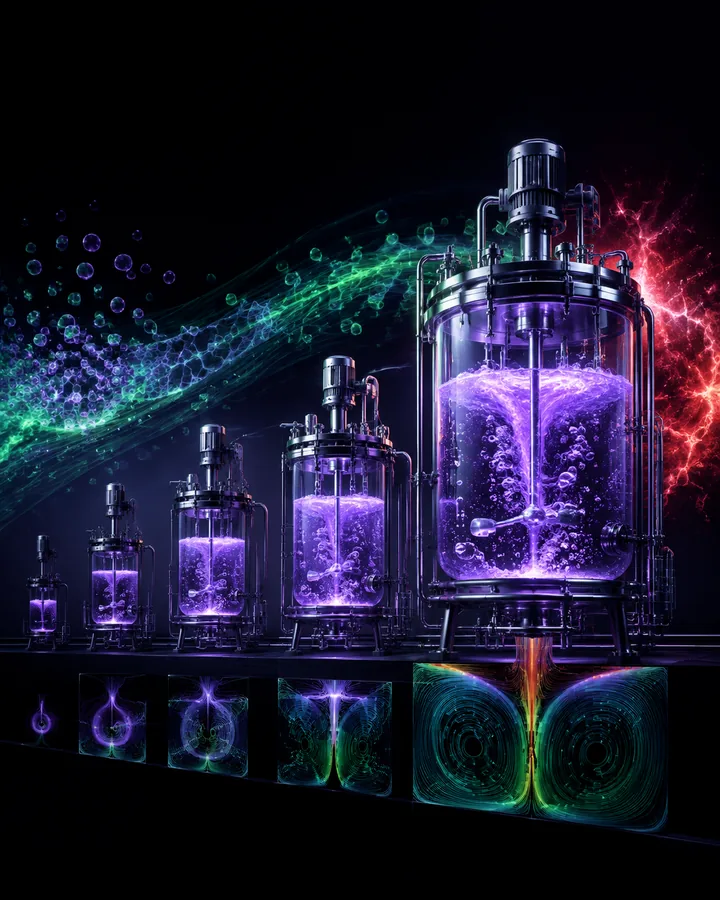
- Build geometrically similar stirred tanks at 2, 20, 200, and 2,000 L.
- Compare constant tip speed, constant power per volume, constant kLa, and a balanced strategy.
- Test conservative, reference, and aggressive fed-batch regimes.
- Calculate biomass, substrate, product, dissolved oxygen, temperature, volume, OTR, OUR, and heat release over 36 hours.
- Measure oxygen limitation, cooling limitation, mixing time, mechanical demand, and final productivity.
Project structure
Project components
Vessel model
Calculates tank and impeller geometry, heat-transfer area, gas velocity, tip speed, power density, clean-liquid kLa, and mixing time.
Scale-up strategies
Selects operating points under constant-tip-speed, constant-power, constant-kLa, and balanced rules.
Fed-batch model
Solves coupled biomass, substrate, product, dissolved-oxygen, temperature, and liquid-volume balances.
Experiment
Runs all combinations of four scales, four strategies, and three feed regimes.
Evidence
Retains case metrics, five-minute time series, operating points, structured summaries, and eight labelled figures.
Methodology
Project workflow
- 01Select scale
Choose a 2, 20, 200, or 2,000 L geometrically similar vessel.
- 02Select strategy
Apply one declared scale-up rule within tip-speed, power, and aeration limits.
- 03Select feed
Choose the conservative, reference, or aggressive fed-batch profile.
- 04Run the model
The solver calculates the coupled biological, oxygen-transfer, and thermal response for 36 hours.
- 05Compare evidence
Tables and figures show productivity, oxygen limitation, temperature, mixing, power, gas flow, and scale tradeoffs.
Demonstration scenario
At 2,000 L with the reference feed, constant tip speed produces 7.01 g/L product. Constant power per volume produces 15.16 g/L but reaches 32.36 C and needs much greater mechanical power. The balanced case holds clean-liquid kLa near 294 per hour with lower aeration, allowing the student to defend the tradeoff instead of naming one universal best rule.
Engineering
Tools and method
- Tools
- The project uses Python, SciPy, NumPy, Pandas, Matplotlib, Jupyter for subject analysis, simulation, and results.
- Engineering calculations
- Python implements geometric similarity, impeller power, gas velocity, kLa, mixing-time, and heat-transfer relations.
- Dynamic simulation
- SciPy integrates the six-state fed-batch model at every selected operating point.
- Experiment design
- A controlled 48-case matrix separates the effects of scale, operating strategy, and feed intensity.
- Evidence
- Pandas, JSON, and Matplotlib retain all comparison tables, time histories, summaries, and figures.
- Verification
- Automated tests cover equations, constraints, physical limits, case counts, reproducibility, and figures.
Testing
Evaluation
Evaluation measures
- Clean and effective kLa across scale
- Tip speed, power per volume, gas flow, and mixing time
- Final biomass, substrate, product concentration, and product mass
- Minimum dissolved oxygen and oxygen-limited hours
- Maximum temperature, heat release, and cooling-limited hours
- OTR to OUR margin through the fed-batch run
Project boundaries
- The model uses generic declared teaching assumptions and is not calibrated for a named organism, strain, medium, product, impeller, or sparger.
- Clean-liquid kLa correlations do not replace measured oxygen-transfer tests in the real broth and vessel.
- The lumped model cannot resolve local oxygen, substrate, temperature, shear, bubble-size, or mixing gradients.
- Real scale-up requires laboratory and pilot data, equipment limits, contamination controls, safety review, and qualified bioprocess engineering judgement.
Included
- 01Complete bioreactor scale-up model and Python study workflow
- 02Forty-eight completed dynamic simulation cases
- 03Four vessel scales, four scale-up strategies, and three feed regimes
- 04CSV, JSON, and eight result figures
- 05Twenty-nine automated tests with 100 percent combined coverage
- 06Complete project files, calculations, results, and analysis material in a private GitHub repository
- 0798-page project documentation in PDF and editable Word formats
- 0821-page setup and usage guide in PDF and editable Word formats
- 09Forty-five annotated references
Project record
No information is collected on this page.
- Permanent project ID
- GP-BT-0535M8H
- Catalogued
- 21 Aug 2026
- Completed
- 24 Aug 2026
- Verified
- 24 Aug 2026
- Demonstration
- Included in repository
Handover
After purchase
- 01Payment is confirmed
The project is marked unavailable and cannot be purchased again.
- 02Repository access is granted
The buyer's submitted GitHub account receives access to the private repository.
- 03The purchase record is delivered
The certification sheet is prepared from the reviewed buyer details and sent privately by email.