Data-Calibrated Microbial Cross-Feeding and Coexistence Robustness Study
A completed biotechnology study of four-species microbial persistence, carbon-source niches, spent-medium effects, chemostat occupancy, and consumer-resource model robustness.
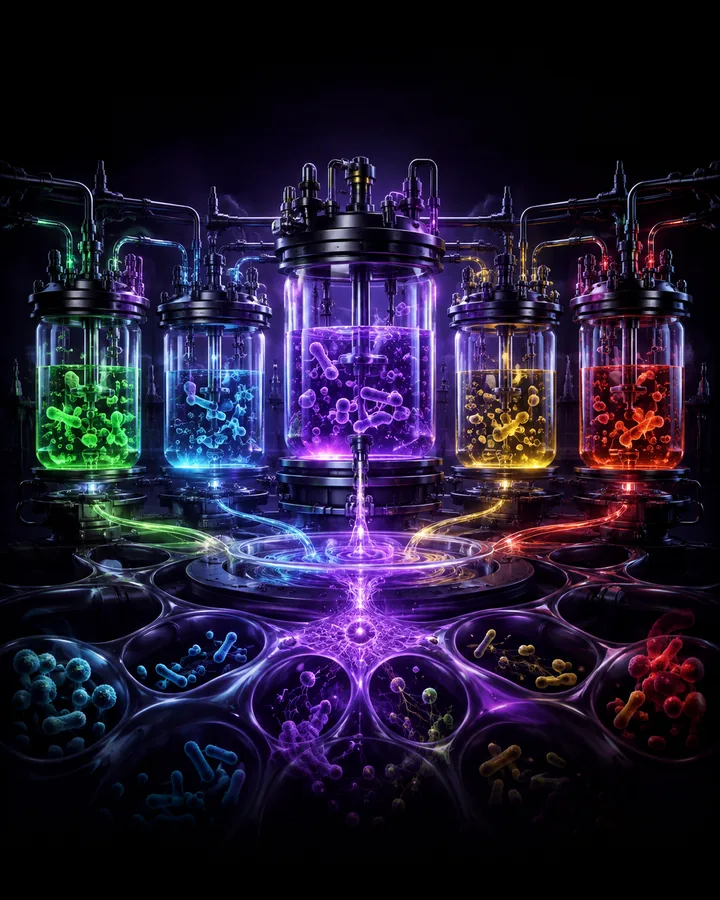
Project definition
Problem statement
A microbial community can persist even when individual members cannot use every supplied carbon source, but persistence alone does not identify the exchanges or conditions that support coexistence.
The biotechnology problem is to combine released phenotype, community, spent-medium, and chemostat evidence with a transparent consumer-resource model while keeping measured observations separate from model scenarios.
Project objectives
- Validate and retain the seven released source tables with exact checksums.
- Measure carbon-source breadth and identify direct-growth gaps across four organisms.
- Summarise community persistence, diversity, culturable abundance, and chemostat occupancy.
- Classify significant positive and negative spent-medium effects without assigning unmeasured metabolites.
- Build a declared consumer-resource model and test leakage, dilution, member dropout, and parameter uncertainty.
- Retain complete tables, figures, tests, references, documents, and scientific claim boundaries.
Project structure
Project components
Evidence validation
Checks retained file hashes, schemas, condition counts, species labels, and reproducible summaries.
Phenotype and assembly analysis
Measures resource breadth, fitted growth-rate patterns, four-member persistence, diversity, and culturable abundance.
Interaction analysis
Classifies adjusted-significant spent-medium effects and builds a directed evidence network without naming unmeasured compounds.
Consumer-resource model
Simulates Monod uptake, maintenance, dilution, leakage, secretion, biomass, and secondary-resource dynamics.
Robustness experiments
Runs leakage and dilution sweeps, four member-dropout scenarios, and 160 seeded parameter draws.
Evidence and verification
Retains source checksums, fourteen result tables, sixteen figures, tests, references, documents, and a Docker gate.
Methodology
Project workflow
- 01Verify public evidence
Confirm the seven retained tables and reproduce phenotype, assembly, interaction, and chemostat summaries.
- 02Construct the model
Load the declared four-species parameterisation and initialise biomass and resource states.
- 03Run the baseline
Integrate the deterministic model and compare final richness with the retained coexistence evidence.
- 04Test robustness
Vary leakage and dilution, remove each member, and perturb uptake, leakage, and dilution under a fixed seed.
- 05Interpret the study
Use the retained evidence and scenario results while preserving the biological validation boundary.
Demonstration scenario
All four organisms remain detected across all sixty-four retained assembly conditions and all four final chemostat observations. The baseline model also retains four members with total biomass 5.5985 model units, while the dilution sweep, member removal, and parameter uncertainty show that coexistence is conditional rather than guaranteed.
Engineering
Tools and method
- Tools
- The project uses Python 3.12, NumPy, Pandas, SciPy, NetworkX, Matplotlib for subject analysis, simulation, and results.
- Data preparation
- Pandas validates and summarises the retained public CSV evidence.
- Dynamic model
- SciPy integrates a declared consumer-resource system with Monod uptake, maintenance, washout, leakage, and secretion.
- Network analysis
- NetworkX represents adjusted-significant directed spent-medium evidence.
- Scenario experiments
- NumPy and deterministic seeds support parameter sweeps, dropout experiments, and uncertainty samples.
- Evidence
- CSV, JSON, PNG, PDF, and Word files preserve source identity, calculations, figures, interpretation, and report content.
- Verification
- Tests, linting, dependency audits, checksums, accessibility checks, repository validation, and non-root Docker execution verify the handover.
Testing
Evaluation
Evaluation measures
- Carbon-source growth breadth across thirty-three tested conditions
- Four-member detection across sixty-four assembly conditions and four chemostats
- Positive and negative adjusted-significant spent-medium effects
- Baseline richness, final composition, and resource trajectories
- Richness and total biomass across leakage and dilution scenarios
- Member-dropout response and richness under 160 uncertainty draws
- Automated tests, dependency audit, document checks, and non-root Docker execution
Project boundaries
- The project is a secondary analysis of released public data and does not claim original wet-lab experimentation.
- Spent-medium responses do not identify the exchanged molecules or prove a universal interaction sign.
- The secretion tensor and several model parameters are declared scenario assumptions rather than fitted biochemical measurements.
- The results do not establish application safety, industrial performance, environmental behavior, or clinical relevance.
- Stronger validation requires metabolomics, isotope tracing, replicated leave-one-out communities, and application-specific experiments.
Included
- 01Complete microbial cross-feeding analysis and modelling source code
- 02Seven retained public source tables with exact checksums
- 03Fourteen generated result tables and sixteen analytical figures
- 04Assembly, spent-medium, chemostat, model-sweep, dropout, and uncertainty evidence
- 05Twenty-four automated tests with 99.24 percent branch-aware coverage
- 06Complete project files, calculations, results, and analysis material in a private GitHub repository
- 0771-page project documentation in PDF and editable Word formats
- 0814-page setup and usage guide in PDF and editable Word formats
- 09Forty-five annotated references
Project record
No information is collected on this page.
- Permanent project ID
- GP-BT-0TTUU9Q
- Catalogued
- 21 Aug 2026
- Completed
- 27 Aug 2026
- Verified
- 27 Aug 2026
- Demonstration
- Included in repository
Handover
After purchase
- 01Payment is confirmed
The project is marked unavailable and cannot be purchased again.
- 02Repository access is granted
The buyer's submitted GitHub account receives access to the private repository.
- 03The purchase record is delivered
The certification sheet is prepared from the reviewed buyer details and sent privately by email.