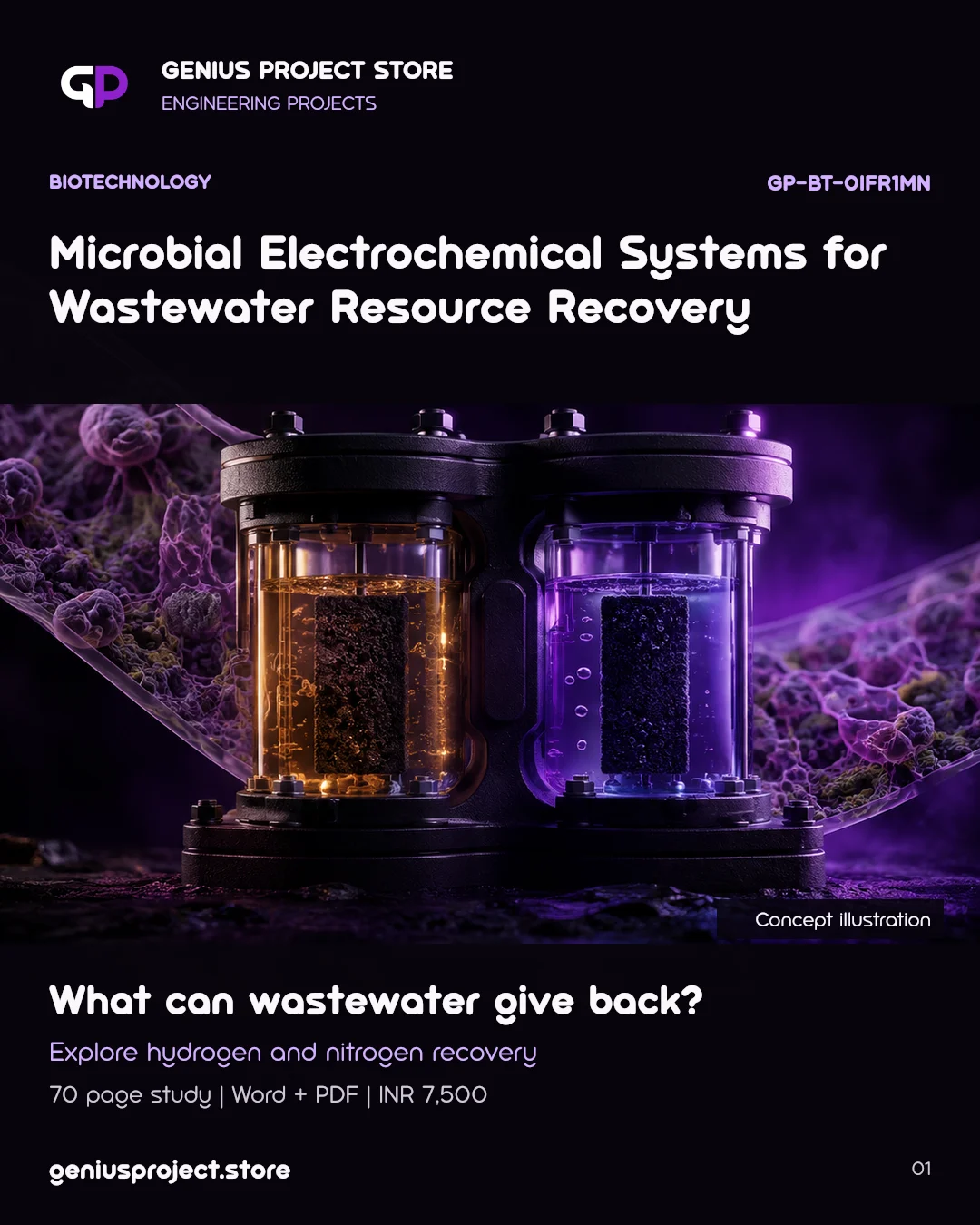
Microbial Electrochemical Systems for Wastewater Resource Recovery
Explore how wastewater composition, electrical charge and collection losses affect hydrogen and nitrogen recovery.
Software compatibility
PDF and editable Word explain the complete study. Optional Python calculations run offline with no third-party runtime dependencies. Matplotlib is only needed to rebuild plots. Git is optional for ZIP delivery.
Project definition
Problem statement
COD removal does not tell us how much hydrogen can be recovered. Electron recovery, gas collection and external energy inputs each change the result.
Nitrogen transported through a membrane is not necessarily nitrogen collected as a product. Published studies also use different boundaries, denominators and operating conditions.
Project objectives
- Connect wastewater COD, charge, hydrogen and nitrogen through explicit balances.
- Separate stack electricity from expanded energy use and unknown auxiliary loads.
- Find conditional COD-to-TAN limits for a stated nitrogen-collection target.
- Reconcile electrical traces, gas measurements and nitrogen inventories.
- Explore uncertainty without calling assumed bounds confidence intervals.
- Explain how ammonia equilibrium differs from cumulative ideal extraction.
Project structure
Project components
Literature review
Seventeen annotated sources cover pilot systems, transport, electron transfer, uncertainty and conditional chemistry. Access limits remain explicit.
Daily balances
An idealized model connects removed COD to recovered charge and hydrogen, with separate transported and collected nitrogen.
Measurement checks
Matched-window current and voltage integration, gas reference conditions and nitrogen inventory checks expose incompatible comparisons.
Feasibility and uncertainty
Forward and inverse composition studies, shared-charge recovery bounds and energy extrema keep assumptions visible.
Ammonia chemistry
Two-species equilibrium and a constant-pH perfect-sink limit explain why instantaneous free ammonia is not a cumulative recovery ceiling.
Methodology
Project workflow
- 01Set the boundary
State flow, concentration basis, recovery assumptions and the energy inputs included.
- 02Read the sources
Distinguish published observations from illustrative calculations and check each source annotation.
- 03Run the balances
Reproduce the retained results or change one assumption in a separate output folder.
- 04Test the interpretation
Check conservation, feasibility, missing measurements and sensitivity before comparing outcomes.
- 05Discuss the limits
Explain what the model cannot establish and which further observations would be needed.
Demonstration scenario
At the stated base assumptions, the model gives 0.0252 kg of hydrogen per day but a slightly negative expanded energy balance. Reducing the assumed auxiliary electricity changes that balance without changing hydrogen production. This is an accounting example, not measured reactor performance.
Engineering
Tools and method
- Tools
- The project uses Python 3.12, Matplotlib for subject analysis, simulation, and results.
- Engineering report
- Introduction, literature review, theory, methodology, results, discussion, conclusions and further work are supported by labelled figures, tables and annotated references.
- Offline calculations
- Python provides the numerical model. There is no website, cloud service, database or paid simulation software to operate.
- Independent verification
- Closed-form examples, conservation identities and high-precision Decimal checks test the calculations. Delivery hashes protect the retained results.
- Editable documentation
- Word files can be adapted while preserving attribution and updating contents after pagination changes.
Testing
Evaluation
Evaluation measures
- Mass, charge and energy conservation under stated assumptions
- Separate transported and collected nitrogen quantities
- COD-to-TAN feasibility and collection ceilings
- Electrical integration and gas reference conditions
- Shared-input uncertainty and unknown nitrogen storage
- Equilibrium, ideal extraction and cross-platform numerical reproduction
Project boundaries
- All retained numerical scenarios are illustrative assumptions, not laboratory measurements.
- The migration-only core does not predict microbial kinetics, diffusion, fouling, pH or operating voltage from a reactor design.
- Ideal extraction uses dimensionless exposure and does not predict treatment time or reagent dose.
- No wet-lab procedures, hydrogen-equipment instructions, drinking-water claim or environmental approval is supplied.
- No information collected.
Included
- 0170-page project documentation in PDF and editable Word formats
- 02Four-page setup and usage guide in PDF and editable Word
- 03Editable 20-slide presentation with source notes, six tables and five charts
- 0417 annotated references, source matrix and an attributed pilot-reactor photograph
- 05Six labelled figures, seven tables and 15 native editable display equations
- 06Complete Python source, eleven CSV tables and a JSON results summary
- 07COD-to-TAN feasibility, trace integration and measurement-uncertainty studies
- 08Conditional ammonia speciation and ideal extraction calculations
- 09116 numerical tests, 19 document and presentation tests, and Linux and Windows CI
Project record
No information is collected on this page.
- Permanent project ID
- GP-BT-0IFR1MN
- Catalogued
- 21 Aug 2026
- Completed
- 07 Sept 2026
- Verified
- 07 Sept 2026
- Demonstration
- Included in repository
Handover
After purchase
- 01Payment is confirmed
The project is marked unavailable and cannot be purchased again.
- 02Repository access is granted
The buyer's submitted GitHub account receives access to the private repository.
- 03The purchase record is delivered
The certification sheet is prepared from the reviewed buyer details and sent privately by email.