Wastewater-to-single-cell-protein process model
A completed circular-biotechnology study of nutrient removal and single-cell-protein recovery from soybean-processing wastewater using a sequencing batch reactor model.
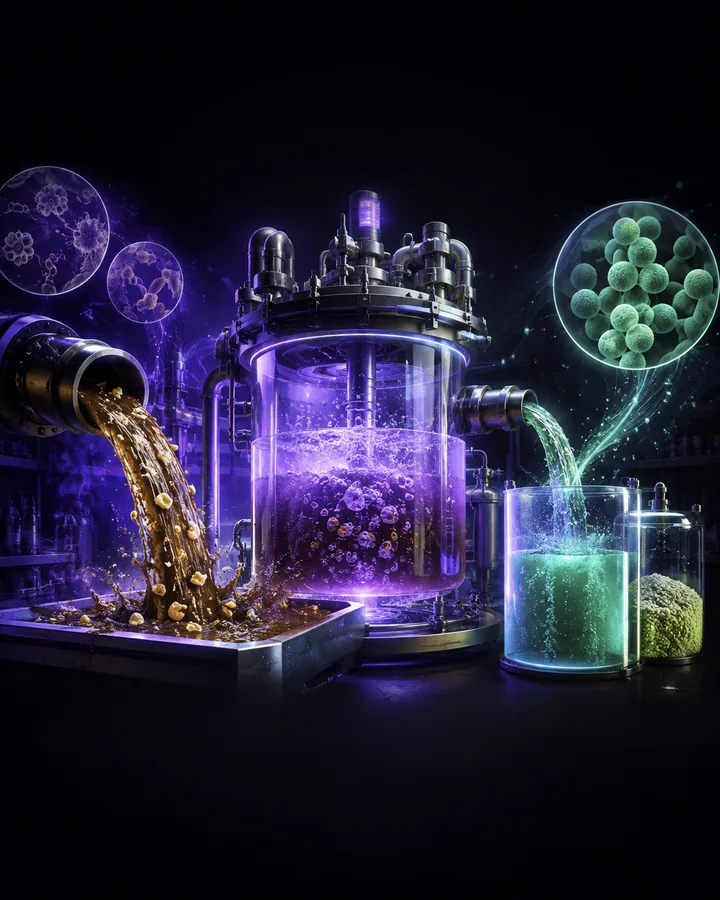
Project definition
Problem statement
Food-processing wastewater contains carbon and nutrients that can support microbial growth, but treatment performance, biomass recovery, protein content, refinement loss, RNA reduction, and energy demand must be considered together.
The engineering problem is to connect wastewater treatment and protein recovery through transparent balances while separating literature calibration from independent experimental validation.
Project objectives
- Model carbon, nitrogen, and phosphorus removal across declared influent and hydraulic-retention-time conditions.
- Calculate biomass productivity, dry-product recovery, protein production, RNA content, and effluent quality.
- Compare unseeded and inoculated operation under unrefined and 60 C heat-refined product routes.
- Measure refinement mass loss, protein enrichment, RNA reduction, amino-acid index, and energy demand.
- Quantify parameter uncertainty with 1,000 deterministic samples and retain all sampled inputs.
- Compare the reference case with a 2026 sequencing-batch-reactor study as an explicit calibration benchmark.
Project structure
Project components
Process model
Calculates nutrient removal, limiting nutrients, biomass growth, product recovery, composition, effluent quality, and energy use.
Case matrix
Runs 144 combinations of influent COD, nitrogen, retention time, inoculation, and refinement route.
Refinement model
Compares untreated biomass with a 60 C heat step using declared loss, protein, RNA, and amino-acid factors.
Uncertainty study
Runs 1,000 seeded samples and retains both uncertain inputs and calculated outputs.
Evidence builder
Produces CSV and JSON results, summary tables, fourteen labelled figures, tests, and report inputs.
Methodology
Project workflow
- 01Define wastewater
Select COD and nutrient concentrations within the declared soybean-processing wastewater study range.
- 02Set reactor operation
Choose hydraulic retention time and either unseeded or inoculated operation.
- 03Run balances
The model calculates nutrient removal, microbial biomass, effluent quality, and resource recovery.
- 04Select refinement
Compare unrefined product with the declared 60 C heat-refinement case.
- 05Review evidence
Use retained cases, uncertainty results, figures, calibration evidence, and limitations to interpret the design tradeoff.
Demonstration scenario
The reference unrefined case reaches 84 percent COD removal, 78 percent nitrogen removal, 0.2903 g/L/day biomass productivity, and 2.90 kg/day protein. The heat-refined route raises protein fraction and reduces RNA while lowering recovered mass and increasing energy demand.
Engineering
Tools and method
- Tools
- The project uses Python, NumPy, SciPy, Pandas, Matplotlib, Jupyter for subject analysis, simulation, and results.
- Bioprocess model
- Python implements the declared mass-balance, nutrient-limitation, biomass, composition, refinement, and energy equations.
- Experiment design
- A deterministic factorial matrix separates the effects of wastewater strength, nitrogen, retention time, inoculation, and refinement.
- Uncertainty analysis
- Seeded parameter samples measure output ranges and rank influential assumptions.
- Evidence
- Pandas, JSON, and Matplotlib retain complete result tables, summaries, calibration comparisons, and figures.
- Verification
- Tests cover balances, bounds, trends, reproducibility, retained results, documents, references, and container execution.
Testing
Evaluation
Evaluation measures
- COD, nitrogen, and phosphorus removal and effluent concentrations
- Biomass productivity, dry-product recovery, protein production, and yield
- Protein fraction, RNA fraction, amino-acid index, and refinement mass loss
- Aeration, mixing, heating, drying, total, and specific energy demand
- Calibration agreement with the declared 2026 literature benchmark
- Uncertainty distributions, sensitivity ranking, automated tests, dependency audit, and Docker run
Project boundaries
- The model is calibrated to selected values from one 2026 soybean-wastewater sequencing-batch-reactor study and is not independently validated.
- Microbial community, contamination, inhibition, oxygen transfer, settling, harvesting, drying, and product safety are represented through simplified declared assumptions.
- The calculated biomass is not approved food or feed and requires compositional, toxicological, microbiological, regulatory, and process validation.
- Real wastewater and biological work require institutional approval, biosafety controls, waste management, analytical measurements, and qualified supervision.
Included
- 01Complete wastewater-to-single-cell-protein process model
- 02144 completed operating and refinement cases
- 03Carbon, nitrogen, phosphorus, biomass, protein, RNA, and energy balances
- 041,000 seeded uncertainty runs with retained sampled inputs
- 05Fourteen generated result figures and two attributed literature figures
- 0639 automated tests with 99.18 percent source coverage
- 07Complete project files, calculations, results, and analysis material in a private GitHub repository
- 0892-page project documentation in PDF and editable Word formats
- 0917-page setup and usage guide in PDF and editable Word formats
- 1045 annotated references
Project record
No information is collected on this page.
- Permanent project ID
- GP-BT-1IKY0HJ
- Catalogued
- 21 Aug 2026
- Completed
- 25 Aug 2026
- Verified
- 25 Aug 2026
- Demonstration
- Included in repository
Handover
After purchase
- 01Payment is confirmed
The project is marked unavailable and cannot be purchased again.
- 02Repository access is granted
The buyer's submitted GitHub account receives access to the private repository.
- 03The purchase record is delivered
The certification sheet is prepared from the reviewed buyer details and sent privately by email.