DWSIM Reverse-Osmosis Desalination Study
A chemical-engineering study of seawater reverse osmosis covering membrane transport, product quality, recovery, pressure, energy use, design tradeoffs, and uncertainty.
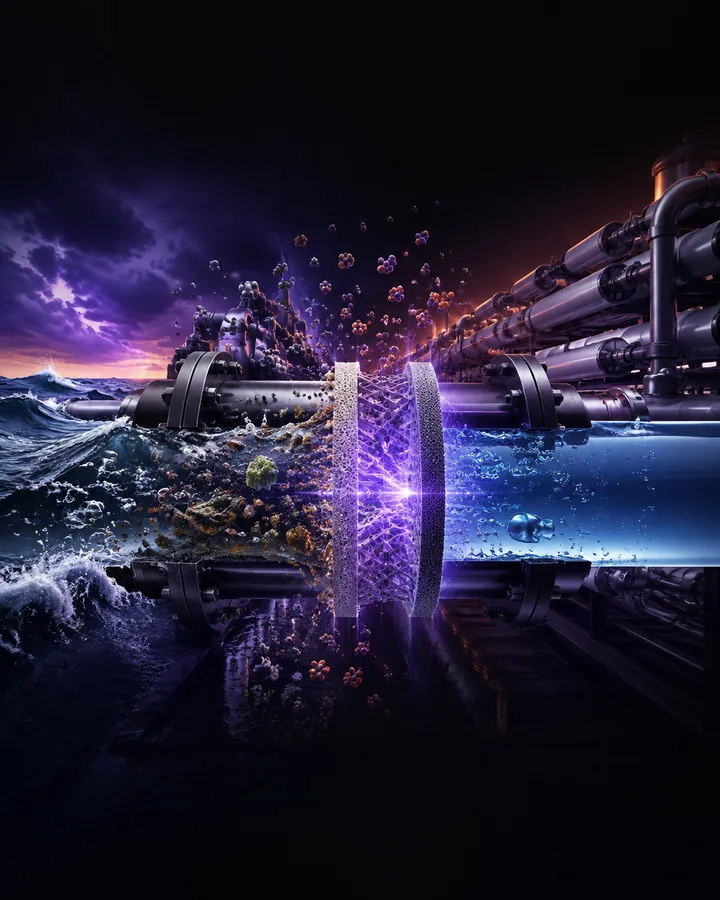
Project definition
Problem statement
Seawater reverse-osmosis performance depends on feed salinity, pressure, temperature, membrane area, concentration polarization, pressure loss, pump efficiency, and energy recovery. Changing one input can improve water production while increasing energy demand or concentrate salinity.
The engineering problem is to calculate these interactions with visible equations, conserve water and salt through the train, compare feasible designs, and verify the independent model in an open process simulator.
Project objectives
- Model a single-pass 100 m3/h seawater reverse-osmosis train with forty membrane segments.
- Calculate permeate flow, recovery, product salinity, brine salinity, rejection, flux, and specific energy consumption.
- Study pressure, feed salinity, temperature, membrane area, and energy-recovery efficiency.
- Screen 630 bounded design cases and retain the feasible Pareto choices.
- Run 2,000 seeded uncertainty cases and calculate result intervals and sensitivities.
- Cross-check the model with a solved DWSIM Core 10.2.3 flowsheet.
Project structure
Project components
Seawater properties
Calculates density, osmotic coefficient, and osmotic pressure inside declared temperature, salinity, and pressure limits.
Membrane model
Solves water flux, salt transport, concentration polarization, pressure loss, and balances across forty segments.
Energy model
Calculates pump demand, recoverable concentrate energy, net power, and specific energy consumption.
Design study
Runs one-variable sweeps, a bounded design screen, Pareto selection, and seeded uncertainty analysis.
DWSIM model
Retains a solved open-core flowsheet with the same transport calculation embedded in a custom unit operation.
Methodology
Project workflow
- 01Set the feed and membrane
Flow, salinity, temperature, pressure, membrane properties, area, losses, and efficiencies are declared.
- 02Solve the train
Each membrane segment updates local pressure, salinity, water flux, salt flux, and remaining feed.
- 03Close the balances
Permeate and brine quantities are checked against total water and salt entering the model.
- 04Run the experiments
Operating sweeps, design combinations, and uncertainty samples are calculated and retained.
- 05Cross-check in DWSIM
The open-core process flowsheet is solved and the retained outlet results are compared with Python.
Demonstration scenario
The released baseline treats 100 m3/h of 35 g/kg seawater at 65 bar and 25 C. It produces 45.316 m3/h of permeate at 0.1454 g/kg, gives 45.316 percent recovery, and requires 2.634 kWh/m3 after idealized energy recovery. The DWSIM model solves all six objects with zero errors and remains within 1.34 percent of the retained Python values.
Engineering
Tools and method
- Tools
- The project uses Python 3.11+, DWSIM Core 10.2.3, NumPy, Pandas, Matplotlib for subject analysis, simulation, and results.
- Engineering model
- Python and NumPy for seawater properties, segment balances, membrane transport, and energy calculations.
- Process simulation
- DWSIM Core 10.2.3 with the Seawater IAPWS-08 property package and an embedded custom membrane unit.
- Experiment design
- Deterministic sweeps, a 630-case design screen, Pareto analysis, and a fixed-seed uncertainty study.
- Data and figures
- Pandas and Matplotlib for retained tables, profiles, tradeoff plots, uncertainty results, and validation figures.
- Verification
- Automated tests cover equations, bounds, trends, balances, retained evidence, and DWSIM assets.
Testing
Evaluation
Evaluation measures
- Permeate production, recovery, and average water flux
- Permeate salinity, brine salinity, and observed salt rejection
- Water and salt balance closure
- Gross and net specific energy consumption
- Feasibility and Pareto tradeoffs across the 630-case screen
- Uncertainty intervals and input sensitivity
- Agreement between Python and DWSIM retained results
- Automated tests, coverage, dependency audit, and repository validation
Project boundaries
- The study is steady state and does not simulate fouling, cleaning, membrane aging, availability, or control transients.
- Salt is represented as a pseudo-component. Boron, individual ions, pH, alkalinity, scaling, and trace contaminants need separate analysis.
- The energy-recovery calculation is an idealized hydraulic credit, not a vendor device model.
- The design screen does not replace membrane-vendor projection software, pilot testing, water analysis, environmental review, or professional plant design.
Included
- 01Complete Python engineering source code
- 02Solved DWSIM Core 10.2.3 process flowsheet
- 03Segmentwise water and salt transport model
- 04630 design cases and 2,000 uncertainty cases
- 05Complete CSV and JSON numerical results
- 0616 analytical figures and a DWSIM process-flow image
- 0787-page project documentation in PDF and editable Word formats
- 088-page setup and usage guide in PDF and editable Word formats
- 0960 annotated references and two sourced literature images
- 1051 automated tests with 99.74 percent statement and branch coverage
Project record
No information is collected on this page.
- Permanent project ID
- GP-CH-03XN29V
- Catalogued
- 21 Aug 2026
- Completed
- 27 Aug 2026
- Verified
- 27 Aug 2026
- Demonstration
- Included in repository
Handover
After purchase
- 01Payment is confirmed
The project is marked unavailable and cannot be purchased again.
- 02Repository access is granted
The buyer's submitted GitHub account receives access to the private repository.
- 03The purchase record is delivered
The certification sheet is prepared from the reviewed buyer details and sent privately by email.