Electrochemical CO2 reactor transport model
A segmented chemical-engineering model for studying mass transfer, CO selectivity, carbon loss, product concentration, and electrical energy in a gas-fed electrochemical CO2 reactor.
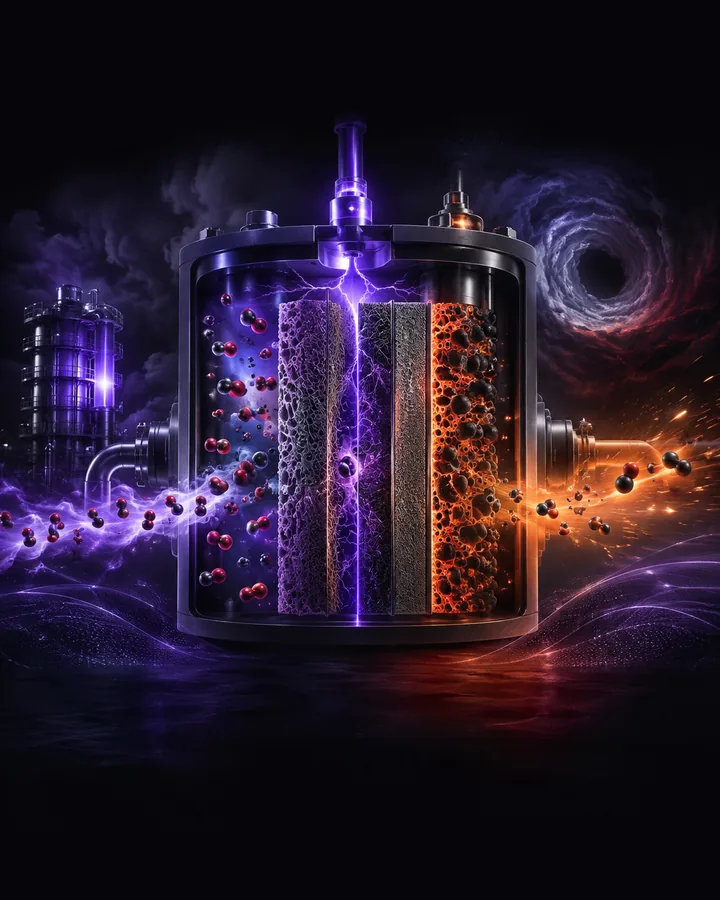
Project definition
Problem statement
Gas-fed electrochemical CO2 reactors can lose selectivity when reactant delivery to the catalyst falls below the electrochemical demand. Restricting the feed can increase conversion while also increasing hydrogen dilution, carbonate loss, and energy per unit product.
The engineering problem is to compare reactor layouts while tracking charge, carbon, axial CO2 availability, outlet composition, voltage, and electrical energy together.
Project objectives
- Model a 25 cm2 reactor with twenty axial control volumes.
- Compare serpentine GDE, flow-through GDE, zero-gap, and staged-feed layouts.
- Run sixty controlled cases across three inlet flows and five current densities.
- Measure CO Faradaic efficiency, conversion, carbon efficiency, outlet CO, voltage, and specific energy.
- Verify bounds, transport trends, segment resolution, and carbon-balance closure.
Project structure
Project components
Reactor layouts
Defines the transport, selectivity, carbonate, resistance, voltage, and feed-staging assumptions.
Axial model
Tracks bulk and catalyst-surface CO2 through twenty reactor segments.
Charge and carbon balance
Allocates current to CO and hydrogen and retains carbonate as a separate carbon loss.
Experiment
Runs all sixty controlled cases and retains the complete result matrix.
Evidence
Writes CSV, JSON, transport plots, performance comparisons, and balance checks.
Methodology
Project workflow
- 01Select a case
Choose the reactor layout, inlet flow, current density, and inlet CO2 fraction.
- 02Calculate transport
The model estimates local limiting current and catalyst-surface CO2 availability.
- 03Allocate charge
Current is divided between CO production and hydrogen competition.
- 04Close carbon
Unreacted CO2, CO product, and carbonate loss are retained in the balance.
- 05Compare results
Product concentration, conversion, carbon efficiency, voltage, and energy are compared.
Demonstration scenario
The sixty-case study compares all four layouts under the same inlet flows and current densities. The best retained outlet CO concentration is 88.80 percent for the zero-gap case at 50 sccm and 200 mA/cm2, while the lowest-energy case occurs under a different condition.
Engineering
Tools and method
- Tools
- The project uses Python, NumPy, Matplotlib, Jupyter for subject analysis, simulation, and results.
- Reactor model
- Python and NumPy for axial material, charge, carbon, voltage, and energy calculations.
- Experiment evidence
- CSV and JSON outputs with Matplotlib figures generated directly from retained results.
- Verification
- Automated checks for physical bounds, directional trends, commands, evidence generation, and carbon closure.
Testing
Evaluation
Evaluation measures
- CO Faradaic efficiency and production rate
- Single-pass conversion and outlet CO concentration
- Carbon efficiency and carbonate loss
- Minimum catalyst-surface CO2 availability
- Average cell voltage and specific electrical energy
- Automated tests, coverage, dependency audit, and carbon residual
Project boundaries
- Parameters are illustrative and are not fitted to a physical reactor.
- The model is steady state, isothermal, and one dimensional.
- It does not model pressure drop, humidity, flooding, salt precipitation, heat, degradation, or downstream separation.
- Results are comparative engineering evidence, not reactor approval or a commercial process guarantee.
Included
- 01Complete Python source code
- 02Serpentine GDE, flow-through GDE, zero-gap, and staged-feed reactor models
- 03Sixty-case experiment with CSV, JSON, and eight result figures
- 04106-page project report in PDF and editable Word formats
- 0517-page setup and usage guide in PDF and editable Word formats
- 0644 annotated references and sourced literature material
- 0753 automated tests with 99 percent statement coverage
Project record
No information is collected on this page.
- Permanent project ID
- GP-CH-1104YQQ
- Catalogued
- 21 Aug 2026
- Completed
- 24 Aug 2026
- Verified
- 24 Aug 2026
- Demonstration
- Included in repository
Handover
After purchase
- 01Payment is confirmed
The project is marked unavailable and cannot be purchased again.
- 02Repository access is granted
The buyer's submitted GitHub account receives access to the private repository.
- 03The purchase record is delivered
The certification sheet is prepared from the reviewed buyer details and sent privately by email.