Electrochemical and Thermochemical Green-Ammonia Route Comparison
A chemical engineering comparison of eight green-ammonia route archetypes across energy, carbon, renewable flexibility, nitrogen feed, materials, durability, purity, safety, scale and evidence quality.
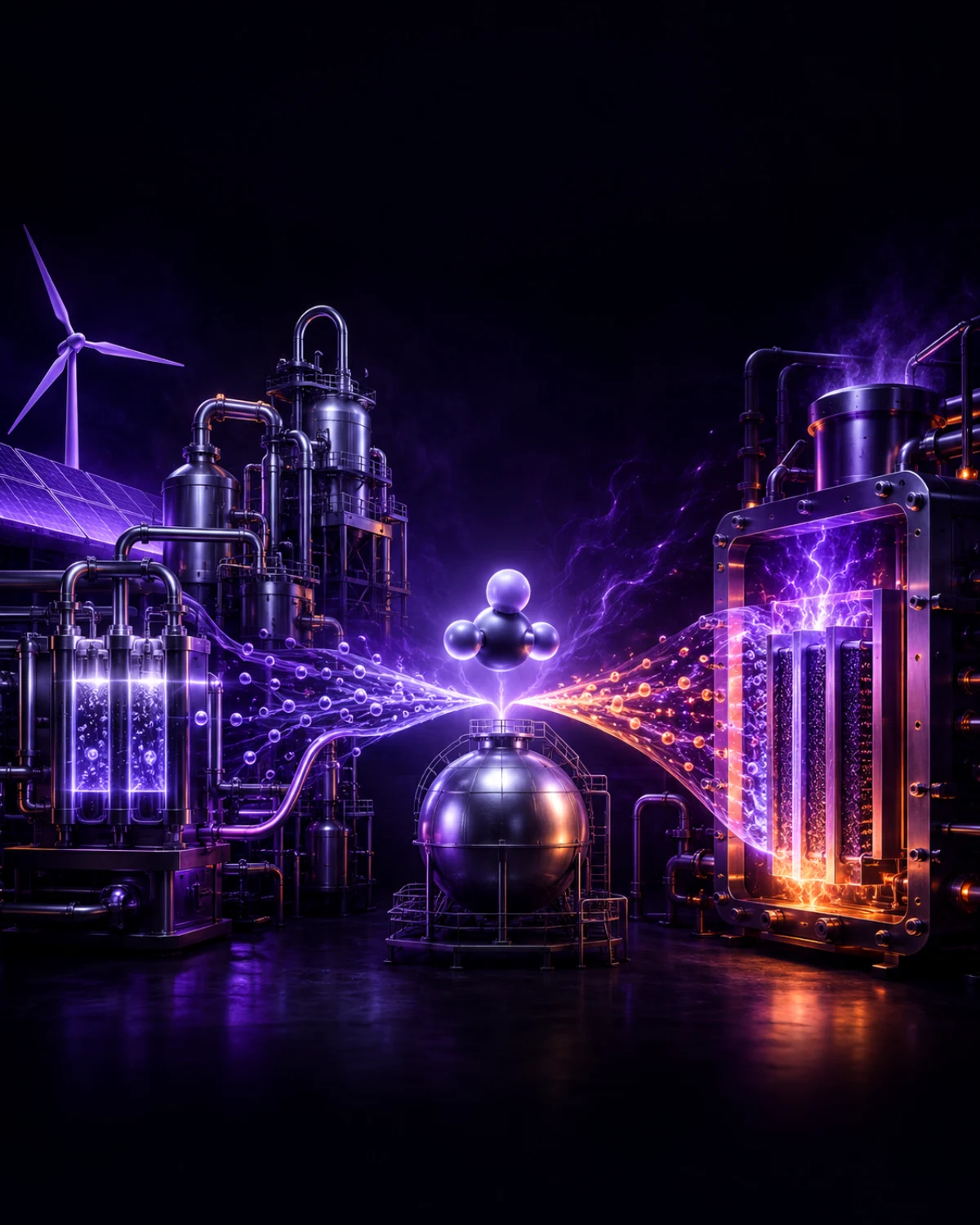
Project definition
Problem statement
Green ammonia can use renewable hydrogen with an established Haber-Bosch loop, or pursue more direct electrochemical and plasma-assisted nitrogen conversion. Published evidence spans different scales, metrics and measurement quality.
The engineering problem is to compare these routes on a common product boundary without presenting catalyst-scale performance, nominal electricity use or one favourable context as proof of complete plant readiness.
Project objectives
- Compare alkaline, PEM and solid-oxide electrolysis coupled to Haber-Bosch with mild-condition, lithium-mediated, protonic, nitrate-reduction and plasma-assisted routes.
- Evaluate energy, operational carbon, renewable flexibility, feed compatibility, materials, durability, purity, safety, scale, economics and measurement assurance.
- Study central, wind, solar, distributed, nitrate-recovery and export contexts.
- Compare direct following, hydrogen-buffered, battery-buffered and hybrid system configurations.
- Test balanced, energy, flexibility and scale-readiness decision priorities.
- Retain hard gates, uncertainty, sensitivity, workflow FMEA and an assurance crosswalk.
Project structure
Project components
Route register
Declares eight route archetypes with transparent process, energy, material, scale and evidence positions.
Context and system model
Crosses six production contexts with four operating configurations while preserving feed and scale constraints.
Decision model
Applies five hard gates and four transparent weighting scenarios to the retained evidence.
Uncertainty model
Runs 30,000 fixed-seed samples per route and retains percentile and threshold results.
Assurance model
Ranks 180 workflow FMEA cells and links route evidence to twelve assurance requirements.
Methodology
Project workflow
- 01Define the product boundary
Nitrogen feed, hydrogen source, electricity, synthesis, separation, recovery, storage and product purity are declared.
- 02Build the comparison matrix
Each route is evaluated across every retained context, system configuration and evidence state.
- 03Apply decision priorities
Balanced, energy, flexibility and scale scenarios expose conditional rankings.
- 04Propagate uncertainty
Fixed-seed sampling tests whether route positions persist when evidence values vary.
- 05Review validation gates
Energy, carbon, feed, scale and measurement weaknesses remain visible beside weighted scores.
Demonstration scenario
Under the retained balanced inputs, electrolysis followed by flexible Haber-Bosch has the strongest industrial evidence. Direct electrochemical routes show modularity and response advantages but remain constrained by energy efficiency, lifetime, product recovery, measurement assurance and demonstrated scale. Nitrate reduction becomes competitive only where nitrate feed and recovery value are present.
Engineering
Tools and method
- Tools
- The project uses Python 3.12, NumPy, Pandas, Matplotlib for subject analysis, simulation, and results.
- Engineering model
- Python and NumPy implement the declared capacity, scale-match, electrical-intensity, carbon and evidence calculations.
- Data analysis
- Pandas retains complete case matrices, route summaries, scenarios, uncertainty, FMEA and assurance results.
- Figures
- Matplotlib generates twelve labelled route, context, energy, flexibility, uncertainty and risk figures.
- Reproducibility
- A fixed seed, explicit configuration, automated tests and Docker reproduce the study.
- Documentation
- The report covers synthesis fundamentals, route evidence, renewable integration, measurement, safety, lifecycle boundaries, methods, results and further work.
Testing
Evaluation
Evaluation measures
- Energy intensity and operational carbon boundary
- Renewable flexibility, minimum load and system compatibility
- Nitrogen-feed compatibility, product purity and recovery
- Materials, durability, safety, scale-up and economic evidence
- Balanced, energy, flexibility and scale-readiness scenario rankings
- Uncertainty intervals, sensitivity, hard gates, workflow FMEA and assurance completeness
- Automated tests, accessibility audits, repository validation and container reproduction
Project boundaries
- Inputs are literature-informed screening positions, not measurements from one operating plant.
- Scores are not plant designs, cost quotations, safety cases, lifecycle certificates or investment recommendations.
- Electricity source, capacity factor, feed availability, product purity, heat integration, storage and scale can change the comparison.
- A site decision requires process simulation, complete balances, representative operating data, product testing, process safety review and qualified engineering assessment.
Included
- 01Complete reproducible Python source code
- 02Eight electrochemical, electrothermal and thermochemical route archetypes
- 03768 deterministic route, context, system and evidence cases
- 04Four decision scenarios with 30,000 uncertainty samples per route
- 05Five hard gates, fifteen validation criteria and 180 workflow FMEA cells
- 06Complete CSV, JSON and twelve analytical figure outputs
- 0789-page project documentation in PDF and editable Word formats
- 0816-page setup and usage guide in PDF and editable Word formats
- 0965 annotated references and two sourced historical literature images
- 10Automated tests, accessibility audits, repository validation and Docker verification
Project record
No information is collected on this page.
- Permanent project ID
- GP-CH-0XPEI9X
- Catalogued
- 21 Aug 2026
- Completed
- 05 Sept 2026
- Verified
- 05 Sept 2026
- Demonstration
- Included in repository
Handover
After purchase
- 01Payment is confirmed
The project is marked unavailable and cannot be purchased again.
- 02Repository access is granted
The buyer's submitted GitHub account receives access to the private repository.
- 03The purchase record is delivered
The certification sheet is prepared from the reviewed buyer details and sent privately by email.