PHA Bioplastic Production Routes: Feedstock, Lifecycle and Techno-Economic Assessment
A chemical-engineering assessment comparing six PHA production routes, three intracellular-polymer recovery methods, three scales, lifecycle bookkeeping choices, cost, uncertainty, application fit, and Pareto tradeoffs.
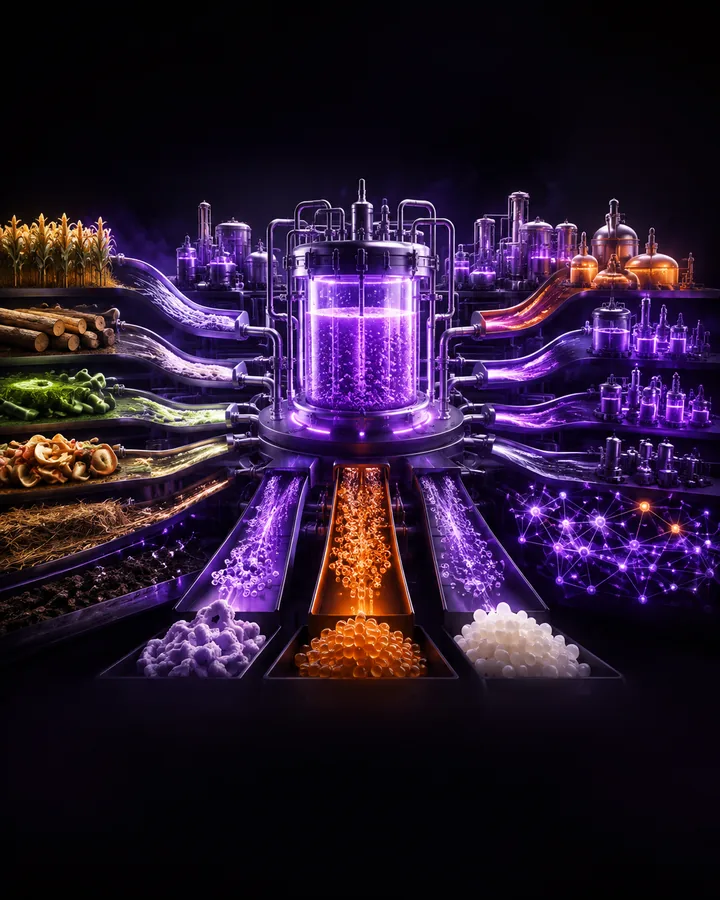
Project definition
Problem statement
PHA is often described as a biodegradable alternative to conventional plastic, but production performance depends on feedstock preparation, microbial culture, fermentation yield and titer, intracellular recovery, energy, water, scale, and lifecycle bookkeeping.
The engineering problem is to compare these coupled choices without treating one laboratory yield, cost estimate, or environmental result as universally transferable to every plant and product.
Project objectives
- Compare refined glucose, molasses, waste cooking oil, crude glycerol, food-waste volatile fatty acids, and lignocellulosic hydrolysate routes.
- Compare solvent recovery, aqueous enzymatic recovery, and selective biomass digestion.
- Evaluate demonstration, regional, and industrial production scales.
- Test cut-off, economic-allocation, and system-expansion lifecycle positions.
- Propagate feedstock, yield, cost, energy, and recovery uncertainty with a fixed random seed.
- Rank route and recovery choices for packaging, biomedical precursor, and agricultural-film applications.
Project structure
Project components
Route evidence model
Declares yield, titer, feedstock cost, lifecycle burden, energy, water, readiness, variability, and possible waste credits for six route archetypes.
Recovery model
Compares recovery yield, purity, energy, water, chemical cost, lifecycle burden, maturity, safety, and polymer-quality positions.
Techno-economic model
Calculates comparative material demand, scaled capital, annualised cost, production cost, and a screening minimum selling price.
Lifecycle model
Retains functional unit, boundary, feedstock burden, electricity, process burden, and alternative waste-credit bookkeeping.
Uncertainty and decision model
Runs fixed-seed sampling, interval summaries, application-specific MCDA, and non-dominated cost-climate screening.
Evidence builder
Writes complete result tables, figures, editable documents, fixed PDFs, accessibility evidence, and repository checks.
Methodology
Project workflow
- 01Declare evidence positions
Route, recovery, scale, boundary, application, and uncertainty assumptions are stored with units and labels.
- 02Build the case matrix
Every route is combined with every recovery method, scale, and lifecycle position to create 162 deterministic cases.
- 03Calculate engineering measures
Mass demand, cost, GWP, water, capital, purity, and readiness are calculated for each case.
- 04Propagate uncertainty
Twenty-thousand fixed-seed samples are run for each of the 18 route and recovery combinations.
- 05Compare decisions
Application rankings and Pareto cases are retained with their weights, boundaries, and limitations.
Demonstration scenario
The retained central regional-scale comparison identifies food-waste mixed culture with selective biomass digestion as the lowest screening cost case at about USD 3.78 per kg. Crude glycerol with halophilic production and selective biomass digestion gives the lowest central cut-off climate position at about 9.31 kg CO2e per kg. The difference demonstrates why one route should not be labelled best without declaring the decision question.
Engineering
Tools and method
- Tools
- The project uses Python 3.12, NumPy, Pandas, Matplotlib for subject analysis, simulation, and results.
- Engineering model
- Python and NumPy implement the declared comparative TEA and LCA equations.
- Data and decisions
- Pandas retains case matrices, uncertainty intervals, application scores, and Pareto results.
- Figures
- Matplotlib generates twelve labelled route, resource, cost, climate, uncertainty, and decision figures.
- Reproducibility
- A fixed seed, retained configuration, complete outputs, automated tests, and a Docker image reproduce the study.
- Documentation
- The report explains PHA science, feedstocks, scale-up, recovery, methodology, results, safety, limitations, and further work.
Testing
Evaluation
Evaluation measures
- Minimum selling price and production-cost structure
- Factory-gate lifecycle GWP under three bookkeeping positions
- Water, energy, feedstock demand, purity, readiness, and variability
- Scale sensitivity and capital position
- Twenty-thousand-sample cost and climate intervals
- Application-specific ranking and Pareto status
- Automated tests, accessibility audits, repository validation, and container reproduction
Project boundaries
- Inputs are literature-informed screening positions, not measurements from one operating plant.
- The economic model is not a bankable estimate and does not include detailed equipment sizing, vendor quotations, ramp-up, financing, or location-specific contracts.
- Lifecycle results are not an environmental product declaration and change with boundary, allocation, electricity, geography, feedstock history, and end-of-life assumptions.
- Polymer grade, molecular weight, residuals, biodegradation setting, safety, regulatory approval, and product certification require experimental and professional validation.
Included
- 01Complete reproducible Python source code
- 02Six feedstock and culture route models
- 03Three intracellular-polymer recovery method models
- 04162 deterministic route, recovery, scale, and lifecycle cases
- 0518 uncertainty summaries using 20,000 samples per route and recovery combination
- 0654 application-ranking cases and a cost-climate Pareto analysis
- 07Complete CSV, JSON, and analytical figure outputs
- 08126-page project documentation in PDF and editable Word formats
- 0916-page setup and usage guide in PDF and editable Word formats
- 1060 annotated references and two sourced literature images
- 11Automated tests, accessibility audits, repository validation, and Docker verification
Project record
No information is collected on this page.
- Permanent project ID
- GP-CH-0DGVOAA
- Catalogued
- 21 Aug 2026
- Completed
- 30 Aug 2026
- Verified
- 30 Aug 2026
- Demonstration
- Included in repository
Handover
After purchase
- 01Payment is confirmed
The project is marked unavailable and cannot be purchased again.
- 02Repository access is granted
The buyer's submitted GitHub account receives access to the private repository.
- 03The purchase record is delivered
The certification sheet is prepared from the reviewed buyer details and sent privately by email.