Circular Design and Material Passports for Modular Buildings
A completed civil engineering study connecting modular design, reversible connections, material passports, open BIM, condition assessment, multi-cycle environmental evidence, logistics and component reuse.
Software compatibility
The retained release and clean Linux container run use Python 3.12. No paid BIM software or confidential building dataset is required to reproduce the study.
Project definition
Problem statement
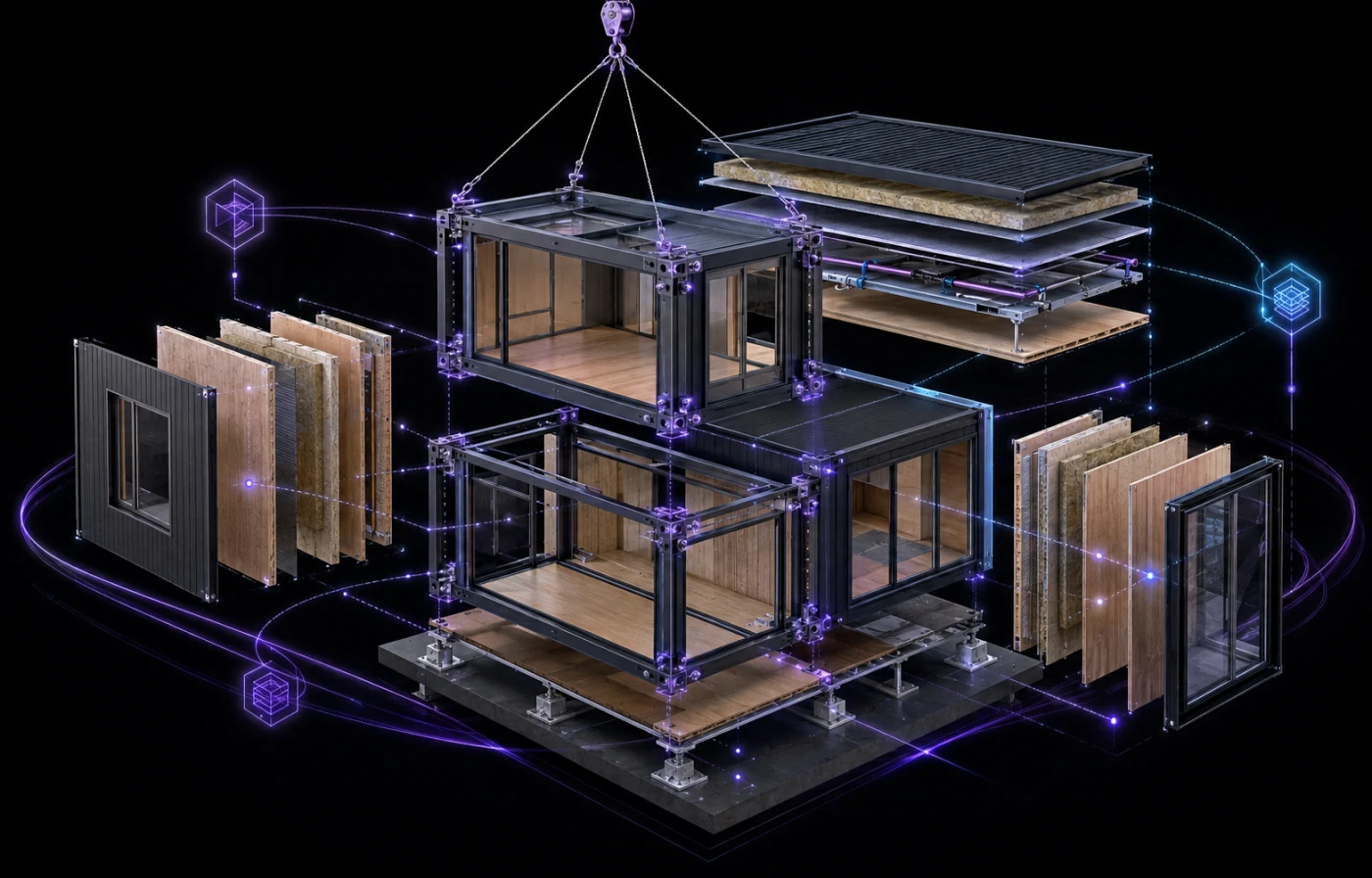
Modular buildings can be manufactured efficiently but still use destructive joints, incomplete handover records and product assemblies that cannot be qualified for a second use.
The engineering problem is to connect physical reversibility, trustworthy material information, as-built and condition evidence, multi-cycle environmental assessment, safe deconstruction and a viable reuse route.
Project objectives
- Compare eight conventional, BIM, passport, disassembly, retained-ownership, component-exchange and integrated delivery frameworks.
- Evaluate twelve circularity and assurance dimensions across nine risk families.
- Keep housing, education, office and temporary-building contexts distinct.
- Compare declared, verified, changed and future-market evidence conditions.
- Test balanced, reuse, carbon and delivery priorities with uncertainty and sensitivity.
- Retain hard physical, information and safety gates beside weighted scores.
Project structure
Project components
Framework register
Declares physical-design, passport, qualification, carbon, market, governance and feasibility positions for eight delivery approaches.
Risk and context model
Crosses nine circular-delivery risks with four modular-building contexts and four evidence conditions.
Decision model
Compares balanced, reuse, carbon and delivery priorities while keeping hard readiness gates visible.
Uncertainty model
Runs 30,000 fixed-seed samples per framework and retains intervals and threshold probabilities.
Workflow assurance
Ranks fifteen criteria across twelve delivery stages and links 120 requirements to framework evidence positions.
Evidence package
Retains CSV, JSON, figures, annotated sources, tests and editable documentation.
Methodology
Project workflow
- 01Define the recovery unit
State whether the intended second-life unit is a complete module, panel, structural member, service cartridge or material.
- 02Design reversible interfaces
Review connection access, separation damage, temporary stability, lifting and replacement sequence.
- 03Specify passport information
Define persistent identity, composition, performance, location, connection, provenance and update fields.
- 04Verify manufacture and assembly
Connect supplier evidence to installed objects and retain substitutions and as-built observations.
- 05Maintain use history
Record changes, maintenance, exposure, damage and condition evidence throughout operation.
- 06Qualify the next use
Assess condition, safety, market, storage, transport and multi-cycle environmental assumptions before reuse.
Demonstration scenario
The integrated framework leads the balanced assessment because reversible physical design, verified passport data, condition assurance, lifecycle governance and a reuse route reinforce one another. Passport-only delivery improves traceability but still fails the irreversible-connection gate, showing why a digital record cannot create circularity by itself.
Engineering
Tools and method
- Tools
- The project uses Python 3.12, NumPy, Pandas, Matplotlib, IFC, IDS for subject analysis, simulation, and results.
- Engineering model
- Python and NumPy implement framework, risk, context, gate and uncertainty calculations.
- Evidence analysis
- Pandas retains all 1,152 cases, scenarios, FMEA, crosswalk and sensitivity outputs.
- Figures
- Matplotlib generates twelve labelled readiness, risk, scenario and uncertainty figures.
- Open information framework
- The report maps passport requirements to IFC, IDS, data templates and digital building logbooks.
- Reproducibility
- A fixed seed, pinned dependencies, eleven tests and Docker reproduce the assessment.
- Documentation
- The report covers circular theory, modular systems, disassembly, passports, BIM, qualification, LCA, procurement, results and further work.
Testing
Evaluation
Evaluation measures
- Design-for-disassembly and connection-reversibility positions
- Material traceability, passport completeness and interoperability
- Condition assessment, structural safety and reuse qualification
- Multi-cycle carbon-evidence readiness
- Market, storage, transport, governance and procurement feasibility
- Balanced, reuse, carbon and delivery scenario rankings
- Uncertainty intervals, dimension sensitivity and hard-gate outcomes
- Exact reproduction of 1,152 retained cases in a clean Linux container
Project boundaries
- Inputs are literature-informed screening positions and sensitivity cases, not measurements from one modular building.
- Scores are not structural designs, fire assessments, product certificates, regulatory approvals or procurement decisions.
- The study does not claim that a passport guarantees disassembly, component reuse or a future buyer.
- Environmental positions are evidence-readiness measures and not a measured building life-cycle assessment.
- Future reuse depends on condition, codes, market timing, storage, transport and acceptance in a new project.
- A real project requires project-specific design, inspection, testing, environmental, cost, legal and safety evidence with qualified review.
Included
- 01Eight circular modular-building delivery frameworks
- 02Twelve design, passport, condition, carbon, market and governance dimensions
- 03Nine risk families and four building contexts
- 041,152 deterministic framework, risk, context and evidence cases
- 0530,000 fixed-seed uncertainty draws per framework
- 06Four decision scenarios, fifteen validation criteria and workflow FMEA
- 07Twelve generated figures and two sourced literature images
- 08Eleven automated tests and clean Docker reproduction
- 09Complete project files, calculations, results and analysis in a private GitHub repository
- 1098-page project documentation in PDF and editable Word formats
- 1116-page setup and usage guide in PDF and editable Word formats
- 1265 annotated references with a complete source matrix
Project record
No information is collected on this page.
- Permanent project ID
- GP-CV-066SN6A
- Catalogued
- 21 Aug 2026
- Completed
- 05 Sept 2026
- Verified
- 05 Sept 2026
- Demonstration
- Included in repository
Handover
After purchase
- 01Payment is confirmed
The project is marked unavailable and cannot be purchased again.
- 02Repository access is granted
The buyer's submitted GitHub account receives access to the private repository.
- 03The purchase record is delivered
The certification sheet is prepared from the reviewed buyer details and sent privately by email.