Concrete chloride-ingress service-life model
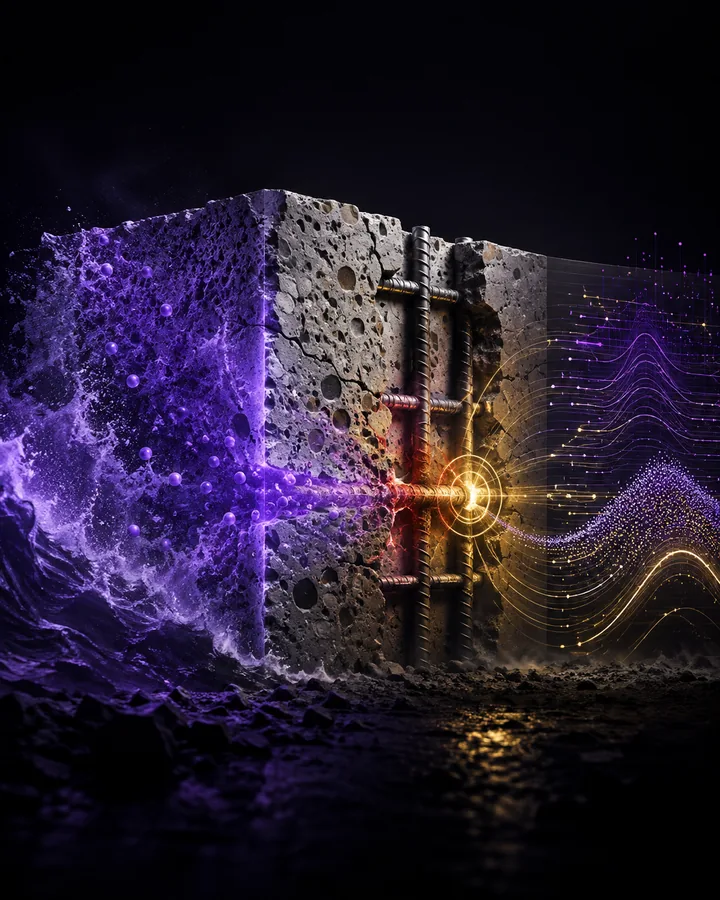
A completed FEniCSx study of chloride transport through reinforced-concrete cover with six engineering cases, analytical verification, convergence and 12,000 uncertainty samples.
Project definition
Problem statement
Chloride can move through concrete cover and initiate reinforcement corrosion before cracking or spalling becomes visible.
A useful service-life study must compare material, cover and exposure while proving that its numerical solution is accurate enough for the stated model.
Project objectives
- Implement one-dimensional apparent chloride transport in current FEniCSx.
- Compare six declared material, cover, temperature and protection cases.
- Verify finite-element profiles against an analytical diffusion-clock solution.
- Measure mesh and time-step convergence.
- Propagate six uncertain inputs through 12,000 reproducible samples.
- Keep initiation results separate from propagation, damage and structural safety.
Project structure
Project components
Transport model
Solves age-dependent and temperature-adjusted apparent chloride diffusion through a 300 mm concrete domain.
Scenario study
Compares baseline OPC, SCM concrete, increased cover, hot low-cover exposure and reduced surface chloride.
Numerical verification
Checks concentration profiles and threshold time against an analytical solution and four refinement levels.
Uncertainty study
Retains 12,000 seeded samples, quantiles, target-year probabilities and rank sensitivities.
Evidence
Writes full tables, twelve project figures, three sourced photographs and editable and fixed documents.
Methodology
Project workflow
- 01Select a case
Choose concrete transport, cover, surface chloride and temperature assumptions.
- 02Solve the chloride field
FEniCSx advances the one-dimensional weak form with backward Euler time integration.
- 03Locate initiation
The workflow interpolates when chloride at reinforcement depth reaches the declared threshold.
- 04Verify the result
Analytical profile error and refinement evidence quantify numerical accuracy.
- 05Interpret uncertainty
Quantiles, target probabilities and sensitivity show how assumptions affect service life.
Demonstration scenario
The baseline OPC case at 50 mm cover reaches the declared threshold at 7.33 finite-element years. SCM concrete at 65 mm remains below threshold through 100 simulated years and has a 115.41-year analytical estimate. The student explains why this remains an initiation-stage scenario result, not a structural-safety prediction.
Engineering
Tools and method
- Tools
- The project uses FEniCSx 0.11.0, Python, DOLFINx, PETSc, NumPy, SciPy, Pandas, Matplotlib, Jupyter for subject analysis, simulation, and results.
- Finite elements
- DOLFINx 0.11.0 uses 240 linear interval elements and monthly steps for the 100-year production study.
- Transport theory
- A 28-day reference coefficient, power-law ageing and Arrhenius thermal factor define apparent diffusion.
- Verification
- An integrated diffusion clock supplies the semi-infinite analytical benchmark.
- Uncertainty
- SciPy Latin-hypercube sampling and root finding propagate six declared independent distributions.
- Reproducibility
- The official FEniCSx image is pinned by digest and the release validator enforces 352 checks.
Testing
Evaluation
Evaluation measures
- Finite-element and analytical initiation time for every case
- Chloride profiles and cover-concentration histories
- Analytical profile RMSE at seven retained ages
- Four-level mesh and time-step convergence
- Service-life quantiles and probability before 50, 75 and 100 years
- Spearman rank sensitivity of six uncertain inputs
Project boundaries
- All material and exposure values are declared teaching assumptions, not measurements.
- The model is one-dimensional and does not separately represent moisture, binding, cracks, corners or spatial variation.
- Threshold crossing represents corrosion initiation only.
- The study does not predict propagation, cracking, spalling, bond loss, capacity or repair urgency.
- Field use requires compatible laboratory data, surveys, physical validation, current standards and qualified engineering review.
Included
- 01Complete FEniCSx chloride-transport model
- 02Six material, cover, exposure and protection cases
- 03Analytical diffusion-clock benchmark and convergence study
- 04Twelve thousand retained uncertainty samples
- 05Fifteen labelled figures and sixteen labelled tables
- 06Twenty-one tests with 94.13 percent branch coverage
- 07Complete project files, calculations and evidence in a private GitHub repository
- 0899-page project documentation in PDF and editable Word formats
- 0921-page setup and usage guide in PDF and editable Word formats
- 10Fifty-five annotated references and three sourced literature photographs
Project record
No information is collected on this page.
- Permanent project ID
- GP-CV-08LUIRV
- Catalogued
- 21 Aug 2026
- Completed
- 26 Aug 2026
- Verified
- 26 Aug 2026
- Demonstration
- Included in repository
Handover
After purchase
- 01Payment is confirmed
The project is marked unavailable and cannot be purchased again.
- 02Repository access is granted
The buyer's submitted GitHub account receives access to the private repository.
- 03The purchase record is delivered
The certification sheet is prepared from the reviewed buyer details and sent privately by email.