Fire Safety and Structural Resilience of Mass-Timber Buildings in Warm Climates
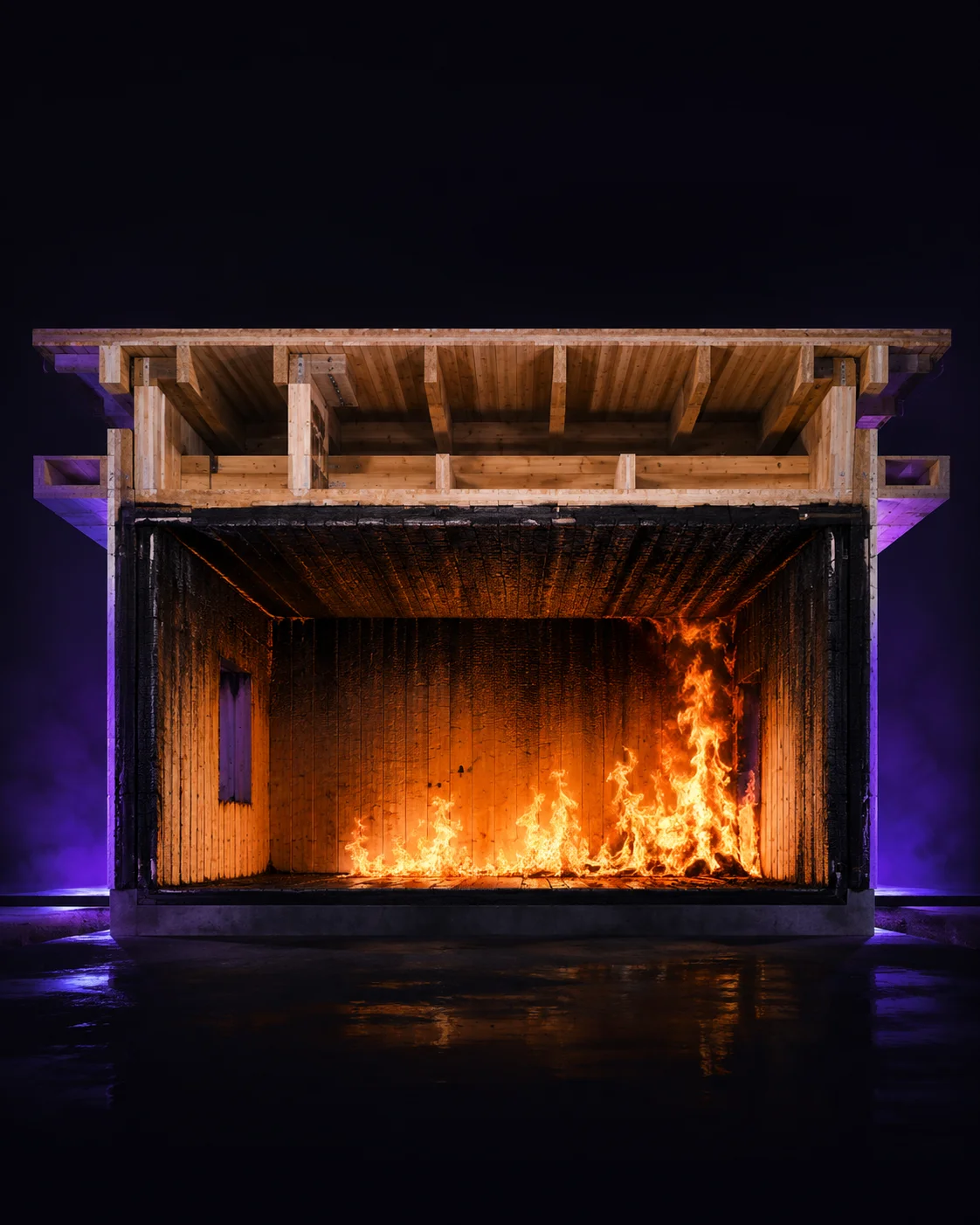
A civil engineering study of published timber-fire experiments, delayed internal heating, structural evidence and warm-climate moisture.
Software compatibility
Includes compact published-data extracts and an offline Docker workflow. No paid fire-modelling software or confidential building data is required.
Project definition
Problem statement
Exposed timber can change fire development, but one peak temperature or heat-release number cannot describe the complete response.
The civil engineering question is how compartment-fire evidence connects to heated structural behaviour, cooling, connections and construction moisture without overstating what the experiments prove.
Project objectives
- Reanalyse six published NIST compartment-fire records with traceable source data.
- Compare common time windows, flashover alignment and peak averaging.
- Verify heat-release integrals and explain differences between peak and cumulative measures.
- Use dimensionless theory to investigate delayed internal heating and section geometry.
- Connect fire evidence with warm-climate moisture and structural resilience literature.
Project structure
Project components
Published experiments
Retains source hashes, extracted heat-release measurements and operator event times for six different configurations.
Data analysis
Computes energy integrals, common and aligned time windows, peak means and adjacent interval totals.
Thermal theory
Demonstrates heat diffusion and delayed internal peaks using dimensionless analytical solutions.
Structural evidence
Reviews heated flexure, connections, delamination, extinction and cooling-phase stability.
Warm-climate interfaces
Examines construction exposure, drying, moisture monitoring and envelope details.
Methodology
Project workflow
- 01Check the sources
Review each experiment, the data manifest and the limitations of the published measurements.
- 02Run the comparisons
Generate the retained heat-release, time-window and peak-sensitivity results.
- 03Explore the theory
Examine dimensionless temperature histories and independent numerical checks.
- 04Interpret the evidence
Connect the numerical findings to material, connection and warm-climate literature.
- 05Extend the study
Choose an explicitly defined research question and identify the additional data or testing it needs.
Demonstration scenario
Test 1-6 has the highest first-hour energy, while test 1-3 has the highest 60-sample mean peak. Changing the observation window changes some comparisons, showing why a ranked result needs a clearly stated measure and time period.
Engineering
Tools and method
- Tools
- The project uses Python 3.12, NumPy, Pandas, Matplotlib for subject analysis, simulation, and results.
- Calculations
- Python, NumPy and Pandas retain signed measurements, consistent units and explicit observation windows.
- Figures
- Matplotlib generates measured-data comparisons and analytical theory figures.
- Verification
- Automated tests cover source integrity, integrals, boundary cases, equations and displayed values. Docker reproduces the workflow offline.
- Documentation
- The report includes introduction, literature review, theory, methodology, results, discussion, limitations, conclusions, further work and annotated references.
Testing
Evaluation
Evaluation measures
- Agreement of generated tables with independently recomputed values
- Sensitivity to comparison windows and peak averaging
- Additivity of adjacent heat-release integrals
- Thermal boundary conditions, stationary peaks and grid accuracy
- Traceability and applicability of the reviewed literature
Project boundaries
- The six configurations are different experiments, not statistical replicates or a controlled estimate of one isolated effect.
- Published calorimeter measurements represent total heat release, not the timber contribution alone.
- Dimensionless theory does not predict a real timber member capacity or a fire-resistance rating.
- The optional strategy scores are author assumptions, separate from measured findings.
- No building approval, code compliance, construction specification or guarantee of safety is provided.
- No information collected.
Included
- 01Six published NIST fire experiments with source hashes and event records
- 02Energy-window, peak-averaging and interval comparisons
- 03Dimensionless thermal diffusion and section-geometry examples
- 0472-page project documentation in PDF and editable Word formats
- 0513-page setup and usage guide in PDF and editable Word formats
- 0617 annotated references and a source matrix
- 07Nine report figures, five tables and two sourced literature photographs
- 08Reproducible Python analysis, retained results and 50 automated tests
- 09Offline Docker workflow and a separately labelled optional comparison exercise
- 10Project ZIP download and private repository access
Project record
No information is collected on this page.
- Permanent project ID
- GP-CV-0IRA1EE
- Catalogued
- 21 Aug 2026
- Completed
- 05 Sept 2026
- Verified
- 05 Sept 2026
- Demonstration
- Included in repository
Handover
After purchase
- 01Payment is confirmed
The project is marked unavailable and cannot be purchased again.
- 02Repository access is granted
The buyer's submitted GitHub account receives access to the private repository.
- 03The purchase record is delivered
The certification sheet is prepared from the reviewed buyer details and sent privately by email.