Masonry seismic-retrofit comparison
A completed OpenSeesPy study comparing as-built, strength-focused, ductility-focused and balanced masonry retrofit archetypes through cyclic, dynamic and uncertainty analyses.
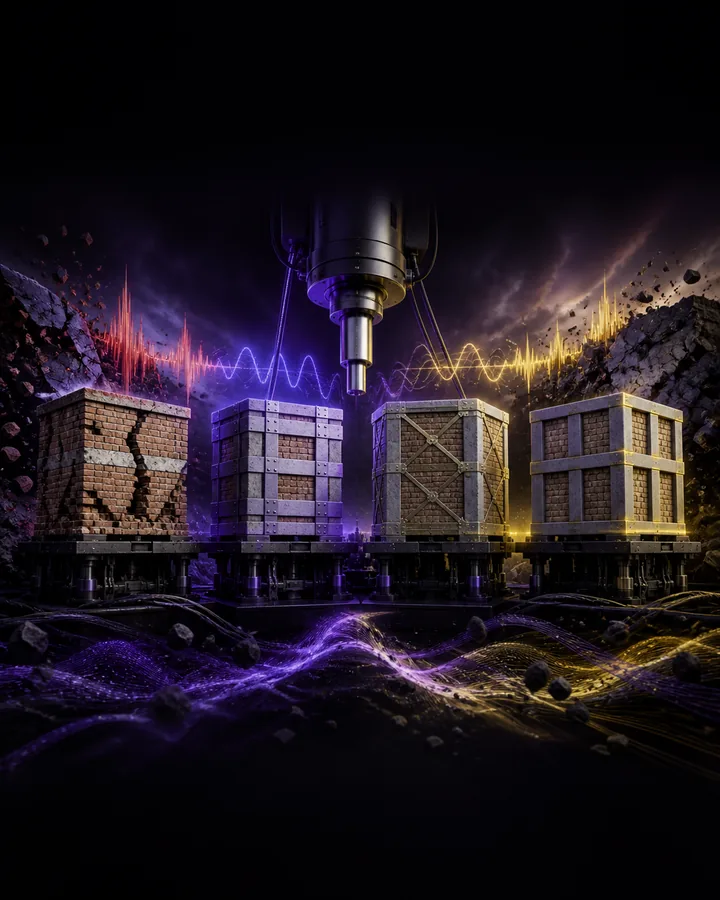
Project definition
Problem statement
Existing masonry can have limited lateral strength, deformation capacity and energy dissipation under repeated earthquake loading.
A useful retrofit comparison must separate strength, ductility and balanced response instead of assuming that the strongest option is always the best option.
Project objectives
- Build one controlled masonry pier model in OpenSeesPy.
- Compare as-built, strength-focused, ductility-focused and balanced archetypes.
- Measure backbone capacity, cyclic energy, stiffness change, drift and residual displacement.
- Run three deterministic synthetic motion families at five intensity levels.
- Propagate material and response uncertainty through 240 reproducible cases.
- Retain complete evidence and state the limits of the simplified model.
Project structure
Project components
Masonry model
Defines one controlled equivalent pier with a nonlinear OpenSeesPy hysteretic material and declared units.
Retrofit archetypes
Changes controlled strength, deformation and unloading parameters for four generic comparison cases.
Cyclic study
Applies a symmetric displacement protocol and measures peak resistance, energy and secant stiffness.
Dynamic study
Runs broadband, long-period and pulse-like synthetic inputs at five peak accelerations.
Uncertainty study
Varies selected model parameters through 240 seeded cases and retains response distributions.
Evidence
Writes open result tables, fifteen engineering figures, tests and complete editable documentation.
Methodology
Project workflow
- 01Select an archetype
Choose the as-built, strength-focused, ductility-focused or balanced case.
- 02Build the model
OpenSeesPy assembles the single-degree-of-freedom masonry pier representation.
- 03Run cyclic loading
The displacement history exposes capacity, pinching, stiffness loss and cumulative energy behaviour.
- 04Run dynamic loading
Synthetic inputs isolate the effects of frequency content and intensity without representing a named earthquake.
- 05Test uncertainty
Seeded parameter cases show how the controlled conclusions change when the model inputs vary.
- 06Interpret the evidence
Tables and figures compare the benefits, tradeoffs and limits of all four archetypes.
Demonstration scenario
The balanced archetype reaches 742.1 kN cyclic peak resistance and 180.65 kJ cumulative energy in the controlled protocol. Its nominal mean peak drift across the synthetic dynamic cases is 0.2463 percent, compared with 1.9861 percent for the as-built archetype. The student explains the strength and ductility tradeoff while keeping these results within the declared model assumptions.
Engineering
Tools and method
- Tools
- The project uses OpenSeesPy 3.8.0.0, Python, NumPy, Pandas, Matplotlib, Jupyter for subject analysis, simulation, and results.
- Nonlinear solver
- OpenSeesPy 3.8.0.0 uses a zero-length spring and Hysteretic material for controlled lateral response.
- Loading protocol
- A symmetric increasing-amplitude displacement history provides comparable cyclic evidence.
- Input motions
- Deterministic broadband, long-period and pulse-like histories are scaled to five declared intensity levels.
- Uncertainty
- Two hundred and forty seeded cases vary declared response properties across the four archetypes.
- Reproducibility
- A digest-pinned Python container, locked package versions and repository validator reproduce the study.
Testing
Evaluation
Evaluation measures
- Backbone capacity and deformation limits for four archetypes
- Cyclic peak resistance, cumulative energy and secant stiffness ratio
- Peak drift and residual displacement across sixty dynamic analyses
- Response trends across five synthetic-motion intensity levels
- Uncertainty distributions and sensitivity evidence from 240 cases
- Thirty-nine automated tests and complete retained result files
Project boundaries
- All geometry, mass, material and motion values are declared teaching assumptions.
- The four archetypes are generic parameter sets and do not represent named commercial retrofit products.
- The model is a controlled single-degree-of-freedom macro-model, not a complete wall, building or foundation model.
- The synthetic motions are not recorded earthquakes and do not represent a site hazard set.
- The study does not provide code compliance, construction details, cost, building safety or a retrofit recommendation.
- Field use requires surveys, tests, site-specific demand, current standards and qualified structural engineering review.
Included
- 01Complete OpenSeesPy masonry response model
- 02Four controlled masonry retrofit archetypes
- 03Cyclic, dynamic and uncertainty analyses
- 04Three clearly labelled synthetic motion families at five intensity levels
- 05304 converged analysis cases and 33,027 retained result rows
- 06Fifteen generated engineering figures and three sourced literature images
- 07Thirty-nine automated tests with 88 percent package coverage
- 08Complete project files, calculations and evidence in a private GitHub repository
- 0970-page project documentation in PDF and editable Word formats
- 104-page setup and usage guide in PDF and editable Word formats
- 11Forty-eight annotated references
Project record
No information is collected on this page.
- Permanent project ID
- GP-CV-1CNTR5N
- Catalogued
- 21 Aug 2026
- Completed
- 27 Aug 2026
- Verified
- 27 Aug 2026
- Demonstration
- Included in repository
Handover
After purchase
- 01Payment is confirmed
The project is marked unavailable and cannot be purchased again.
- 02Repository access is granted
The buyer's submitted GitHub account receives access to the private repository.
- 03The purchase record is delivered
The certification sheet is prepared from the reviewed buyer details and sent privately by email.