OpenSeesPy soil-structure interaction study
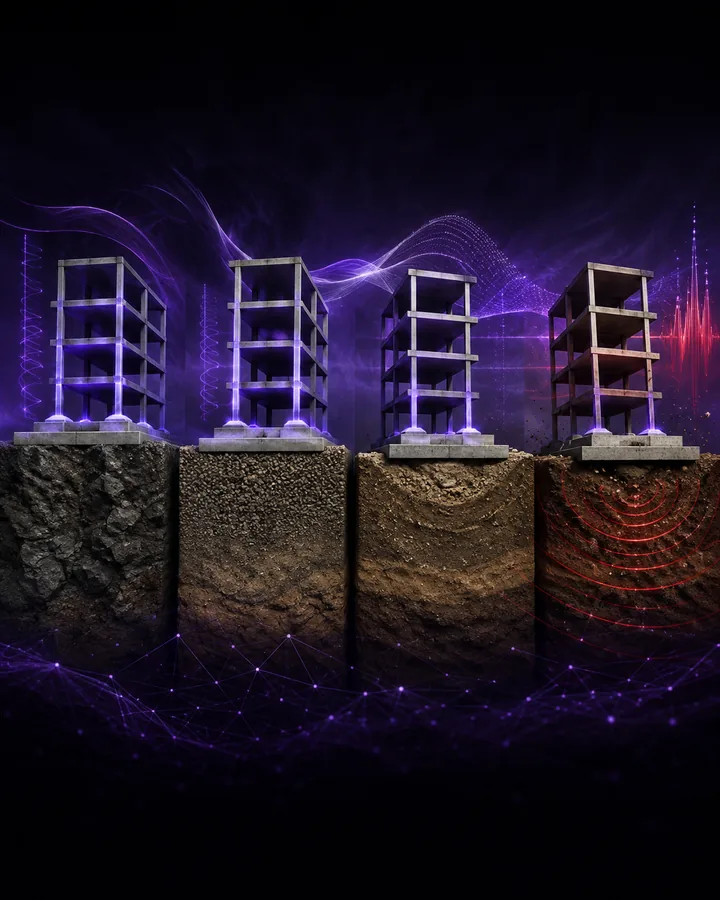
A completed OpenSeesPy study comparing a four-storey frame on fixed, stiff-soil, medium-soil, and soft-soil foundations through settlement, modal, static, dynamic, sensitivity, and uncertainty analyses.
Project definition
Problem statement
A fixed-base building model cannot show foundation translation, settlement, rocking, or the change in structural response caused by finite soil stiffness.
A useful comparison must measure period, drift, roof displacement, base shear, foundation motion, and uncertainty together without claiming that soil-structure interaction is always beneficial.
Project objectives
- Build one controlled four-storey, three-bay reinforced-concrete frame in OpenSeesPy.
- Compare fixed, stiff-soil, medium-soil, and soft-soil support conditions.
- Calculate horizontal, vertical, and rocking foundation impedance from declared footing and soil properties.
- Run gravity, modal, static lateral, and twenty-four response-history cases.
- Measure soil, footing, damping, and combined parameter sensitivity.
- Verify equilibrium, physical trends, independent period estimates, software paths, and retained evidence.
Project structure
Project components
Frame model
Builds the four-storey elastic reinforced-concrete frame with controlled geometry, mass, sections, and floor constraints.
Foundation impedance
Calculates horizontal, vertical, and rocking springs and dashpots for the rigid area-equivalent footing.
Static and modal study
Calculates gravity settlement, equilibrium, four modal periods, and response to a 1000 kN lateral reference load.
Dynamic study
Runs fixed and flexible foundations under broadband, near-fault, and long-period artificial inputs at 0.15 g and 0.30 g.
Sensitivity and uncertainty
Varies soil shear modulus, footing width, damping, mass, elastic modulus, and combined inputs.
Evidence and verification
Retains tables and histories, creates fourteen figures, runs independent checks, and verifies all engineering code branches.
Methodology
Project workflow
- 01Select foundation case
Choose fixed, stiff, medium, or soft support while the superstructure remains unchanged.
- 02Build the coupled model
Rigid links connect the column bases to one footing master supported by three impedance components.
- 03Apply gravity and extract modes
The workflow checks vertical equilibrium, settlement, and four positive modal periods.
- 04Run static and dynamic loading
A triangular reference load and six controlled input motions generate frame and foundation response.
- 05Compare evidence
Retained tables and figures compare drift, displacement, reaction, translation, rocking, sensitivity, and uncertainty.
Demonstration scenario
Soft soil lengthens the first period from 0.82146 to 0.88046 seconds and produces 2.865 mm of elastic gravity settlement. Under the broadband 0.30 g input, peak storey drift rises from 2.477 percent for the fixed base to 2.728 percent for soft soil, while other input shapes show that the direction of the SSI effect is not universal.
Engineering
Tools and method
- Tools
- The project uses OpenSeesPy 3.8.0.0, Python, NumPy, SciPy, Pandas, Matplotlib, Jupyter for subject analysis, simulation, and results.
- Structural solver
- OpenSeesPy 3.8.0.0 assembles elastic beam-column elements, rigid links, zero-length foundation materials, constraints, and analyses.
- Foundation model
- A rigid 18 m by 6 m footing uses area-equivalent elastic half-space stiffness and controlled viscous damping.
- Input motions
- Deterministic broadband, pulse-like, and long-period histories isolate frequency and amplitude effects without representing a named earthquake.
- Analysis
- Python, NumPy, SciPy, and Pandas preserve every case and calculate response envelopes and independent checks.
- Verification
- One hundred and six tests cover valid models, invalid inputs, equilibrium, motion scaling, transient recovery, and failure paths.
Testing
Evaluation
Evaluation measures
- First four modal periods for all four foundation cases
- Gravity settlement and vertical equilibrium
- Static roof displacement, storey drift, foundation translation, and rocking
- Peak dynamic roof displacement, base shear, drift, translation, and rotation
- Sensitivity to soil shear modulus and footing width
- Sixty-case first-period and settlement uncertainty
- Independent equivalent-period difference and complete test coverage
Project boundaries
- The frame, footing, soil, damping, and artificial motions are declared teaching assumptions.
- The model is linear and does not include layered soil, modulus reduction, liquefaction, uplift, sliding, permanent settlement, piles, embedment, or nonlinear structural response.
- The artificial motions are not recorded earthquakes or a site hazard set.
- The study is not a settlement prediction, geotechnical recommendation, structural design, or construction approval.
- Field use requires site investigation, appropriate hazard, validation, current standards, and qualified civil engineering review.
Included
- 01Complete OpenSeesPy frame and foundation model
- 02Fixed, stiff-soil, medium-soil, and soft-soil comparisons
- 03Gravity, modal, static lateral, and response-history analyses
- 04Soil modulus, footing width, damping, and uncertainty studies
- 0514,528 retained analysis rows and 14 labelled project figures
- 06106 automated tests with 100 percent branch-aware core coverage
- 07Complete project files, calculations, and analysis material in a private GitHub repository
- 0870-page project documentation in PDF and editable Word formats
- 0917-page setup and usage guide in PDF and editable Word formats
- 10Fifty annotated references and three licensed literature images
Project record
No information is collected on this page.
- Permanent project ID
- GP-CV-1MO0K0H
- Catalogued
- 21 Aug 2026
- Completed
- 26 Aug 2026
- Verified
- 26 Aug 2026
- Demonstration
- Included in repository
Handover
After purchase
- 01Payment is confirmed
The project is marked unavailable and cannot be purchased again.
- 02Repository access is granted
The buyer's submitted GitHub account receives access to the private repository.
- 03The purchase record is delivered
The certification sheet is prepared from the reviewed buyer details and sent privately by email.