TELEMAC bridge-scour hydraulics simulation
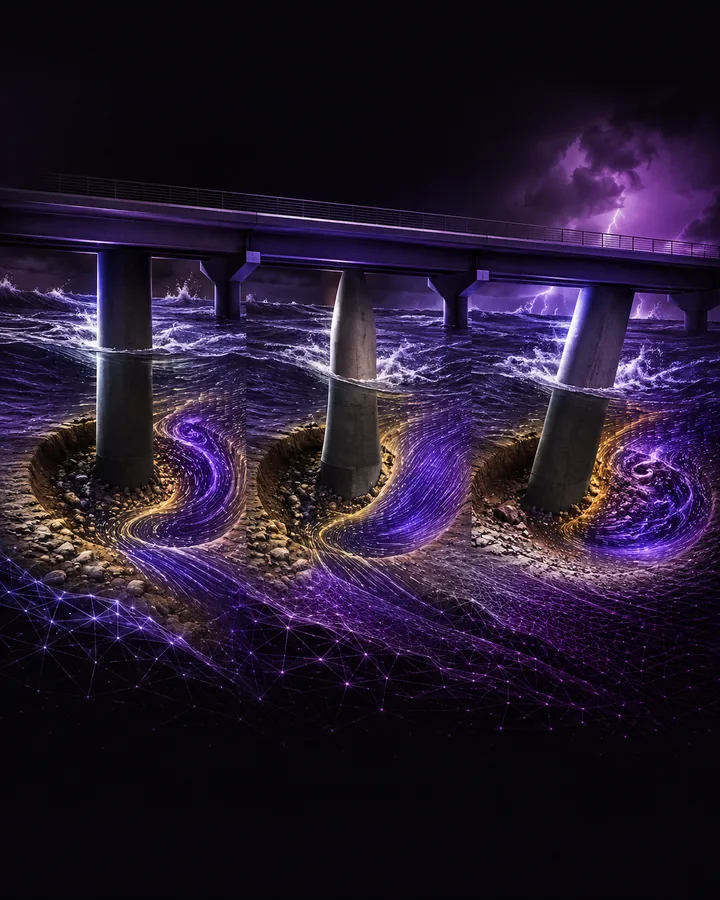
A completed TELEMAC-2D study comparing circular, aligned streamlined, and yawed streamlined bridge piers across three flood discharges.
Project definition
Problem statement
Bridge piers accelerate flow, change separation and wake patterns, and can increase the hydraulic forcing that contributes to local scour.
Pier shape may reduce this forcing when it is aligned with the flow, but the benefit can change under yaw. A useful study must compare the hydraulic fields while separating numerical results from empirical scour screening.
Project objectives
- Build a constrained triangular TELEMAC-2D channel mesh with a true internal pier boundary.
- Compare circular, aligned streamlined, and 20 degree yawed streamlined pier geometries.
- Run each geometry at 45, 70, and 95 cubic metres per second.
- Measure approach conditions, pier-zone acceleration, wake velocity, and Froude behaviour.
- Compare three sediment-mobility indicators and a separate HEC-18 scour screen.
- Check time averaging, boundary buffers, solver completion, conservation, and mesh sensitivity.
Project structure
Project components
Hydraulic geometry
Builds the 80 m by 20 m channel and true circular or elliptical pier boundary on a constrained triangular mesh.
TELEMAC study
Runs nine fixed-bed, depth-averaged simulations for three pier geometries and three discharges.
Field extraction
Retains thirteen output records and calculates time-mean depth, velocity, surface, bed, and Froude fields from the final six records.
Engineering analysis
Calculates approach, pier-zone, wake, sediment-mobility, and separate HEC-18 screening values using declared regions and equations.
Verification
Checks four mesh levels, temporal behaviour, boundary buffers, solver completion, fluxes, field integrity, and reproducible outputs.
Methodology
Project workflow
- 01Select geometry
Choose the circular, aligned streamlined, or yawed streamlined pier.
- 02Select discharge
Choose 45, 70, or 95 cubic metres per second while the channel and roughness remain controlled.
- 03Build the mesh
MeshPy creates the triangular channel mesh with the pier represented as a true internal hole.
- 04Run TELEMAC
The pinned official solver completes 1,800 seconds and stores thirteen field records.
- 05Compare evidence
The final six records are averaged and the retained tables and figures compare geometry, discharge, mobility, and numerical quality.
Demonstration scenario
At 95 cubic metres per second, the aligned streamlined pier gives an HEC-18 screen of about 1.99 m, compared with 2.93 m for the circular pier. Rotating the streamlined pier by 20 degrees raises the screen to about 2.82 m, showing that alignment removes most of the apparent shape benefit in the prepared cases.
Engineering
Tools and method
- Tools
- The project uses TELEMAC-2D, Python, NumPy, Pandas, Matplotlib, MeshPy, Jupyter for subject analysis, simulation, and results.
- Hydraulic solver
- TELEMAC-2D solves fixed-bed, depth-averaged free-surface flow with declared discharge, level, roughness, and turbulence settings.
- Mesh
- Python and MeshPy create a constrained triangular mesh with inlet, outlet, wall, and pier boundary classifications.
- Theory
- Independent Python functions calculate Froude number, Manning relations, Shields mobility, normal depth, and the HEC-18 pier-scour screen.
- Analysis
- NumPy and Pandas process explicit approach, pier-zone, wake, and core-domain regions.
- Figures
- Matplotlib produces ten labelled figures covering the mesh, fields, trends, indicators, convergence, time averaging, and evidence boundary.
- Verification
- Twenty-seven tests and a container workflow check equations, geometry, retained results, ranking, convergence, and delivery integrity.
Testing
Evaluation
Evaluation measures
- Approach speed, depth, and Froude number for all nine cases
- Pier-zone peak speed and velocity amplification
- Wake mean speed
- Sediment-mobility ratios for 0.3, 0.6, and 1.2 mm sand
- Separate HEC-18 screening depth
- Four-level mesh-convergence differences
- Time stability, core-domain behaviour, solver completion, fluxes, and volume error
Project boundaries
- The channel, discharge, depth, roughness, sediment, and pier dimensions are declared teaching assumptions.
- The TELEMAC model is fixed-bed and depth-averaged. It does not simulate an evolving scour hole or resolve three-dimensional horseshoe vortices.
- The Manning-based shear value is an indicator, and the HEC-18 value is a separate empirical screen.
- The study does not predict foundation safety or provide a design scour depth.
- Field use requires site hydrology, bathymetry, sediment and geotechnical data, physical validation, and qualified engineering review.
Included
- 01Complete TELEMAC-2D hydraulic model and Python workflow
- 02Nine completed production simulations
- 03Four-level mesh-convergence study
- 04Retained spatial and temporal result fields
- 05Ten project figures and two attributed literature images
- 06Twenty-seven automated engineering tests
- 07Complete project files, calculations, and analysis material in a private GitHub repository
- 0877-page project documentation in PDF and editable Word formats
- 0916-page setup and usage guide in PDF and editable Word formats
- 10Thirty-five annotated references
Project record
No information is collected on this page.
- Permanent project ID
- GP-CV-0TOVQT2
- Catalogued
- 21 Aug 2026
- Completed
- 25 Aug 2026
- Verified
- 25 Aug 2026
- Demonstration
- Included in repository
Handover
After purchase
- 01Payment is confirmed
The project is marked unavailable and cannot be purchased again.
- 02Repository access is granted
The buyer's submitted GitHub account receives access to the private repository.
- 03The purchase record is delivered
The certification sheet is prepared from the reviewed buyer details and sent privately by email.