Indic document intelligence benchmark
A reproducible OCR, retrieval, and answer extraction benchmark for synthetic English, Hindi, and Kannada administrative documents.
Project definition
Problem statement
OCR performance can change substantially across scripts and scan conditions. A result on clean English pages does not establish performance on Hindi or Kannada documents.
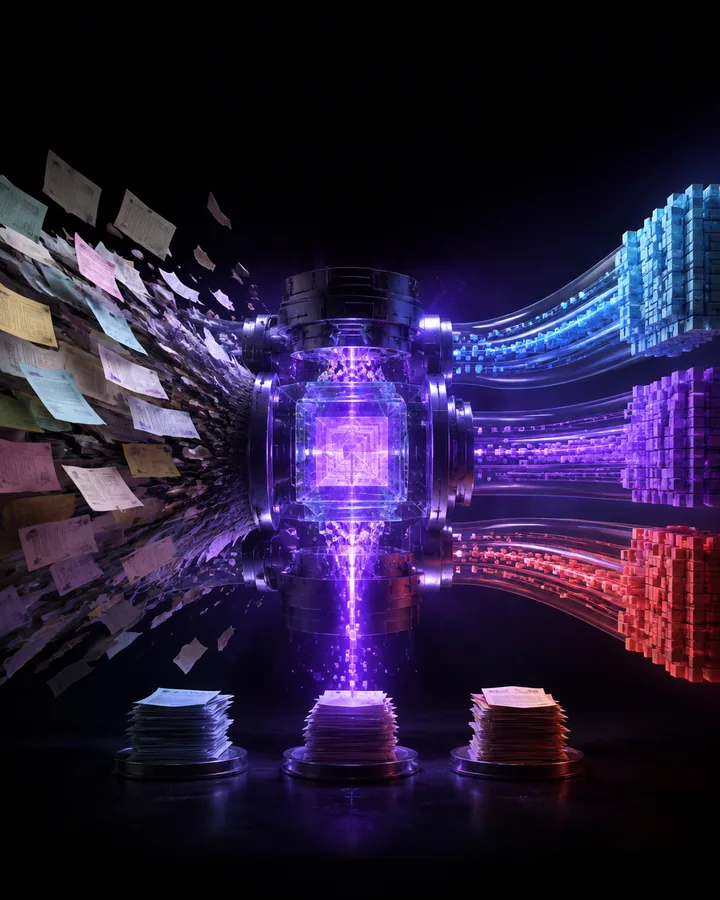
The project separates OCR, retrieval, and answer extraction so that errors can be measured at each stage instead of being hidden inside one final score.
Project objectives
- Create a deterministic synthetic corpus in English, Hindi, and Kannada.
- Compare three local Tesseract configurations under clean, scan, and degraded conditions.
- Compare word and character TF-IDF retrieval on fixed questions and reference passages.
- Measure bounded field extraction with exact match, token F1, and evidence checks.
- Retain every input, result row, figure, configuration, and validation record.
Project structure
Project components
Corpus generator
Builds 27 synthetic administrative notices across three languages, three document types, and three quality conditions.
OCR runner
Runs raw block, preprocessed block, and preprocessed sparse-text Tesseract configurations.
Text evaluation
Normalises Unicode safely and calculates character and word error rates without splitting Indic combining marks.
Retrieval runner
Ranks OCR lines using word and character TF-IDF and records Recall at 1 and mean reciprocal rank.
Answer extractor
Extracts five bounded field categories and records exact match, token F1, and evidence availability.
Evidence outputs
Exports result tables, a JSON summary, nine figures, and a static offline dashboard.
Methodology
Project workflow
- 01Generate documents
Create the fixed synthetic notices, reference text, fields, questions, answers, and corpus manifest.
- 02Run OCR
Process every page with the three declared Tesseract configurations and retain text, error, and latency evidence.
- 03Retrieve evidence
Rank OCR lines for each fixed question with both TF-IDF methods.
- 04Extract answers
Apply the bounded field extractor only to the retained evidence line.
- 05Review results
Rebuild the summary, figures, and dashboard directly from retained CSV and JSON files.
Demonstration scenario
The command-line workflow generates the fixed English, Hindi, and Kannada corpus, runs all three OCR configurations, evaluates two retrieval methods, extracts answers, and rebuilds the retained dashboard. A result can then be traced from its final answer score back to the retrieved evidence and OCR text.
Engineering
Tools and method
- Language and runtime
- Python 3.11 with an installable package and command-line interface.
- OCR
- Local Tesseract 5 with official English, Hindi, and Kannada language data.
- Image preparation
- Pillow for deterministic rendering, grayscale conversion, contrast adjustment, filtering, and thresholding.
- Retrieval
- scikit-learn word and character TF-IDF with cosine similarity.
- Evidence
- CSV and JSON records with Matplotlib figures and a static HTML dashboard.
- Reproducibility
- Docker setup, non-root runtime, fixed corpus manifest, automated tests, and dependency audit.
Testing
Evaluation
Evaluation measures
- Mean character error rate: 4.89 percent
- Mean word error rate: 8.82 percent
- Retrieval Recall at 1: 87.04 percent
- Retrieval mean reciprocal rank: 92.28 percent
- Answer exact match: 55.56 percent and token F1: 57.10 percent
- Thirty-five automated tests with 99.04 percent statement coverage
Project boundaries
- The corpus is synthetic and contains only English, Hindi, and Kannada printed notices.
- It does not represent handwriting, every administrative layout, or every Indic language.
- The Tesseract configurations are local baselines and do not represent all OCR systems.
- Question answering is bounded field extraction and not open-ended generation.
- No buyer, student, university, payment, citizen, or employee information is collected.
Included
- 01Python source and command-line tools
- 02Synthetic English, Hindi, and Kannada benchmark documents
- 03Tesseract OCR, TF-IDF retrieval, and extractive answer pipelines
- 04Retained CSV and JSON results, nine figures, and offline dashboard
- 05Complete source code in a private GitHub repository
- 0683-page project documentation in PDF and editable Word formats
- 0721-page setup and usage guide in PDF and editable Word formats
- 0855 annotated references
Project record
No information is collected on this page.
- Permanent project ID
- GP-DA-1GYWHUI
- Catalogued
- 21 Aug 2026
- Completed
- 25 Aug 2026
- Verified
- 25 Aug 2026
- Demonstration
- Included in repository
Handover
After purchase
- 01Payment is confirmed
The project is marked unavailable and cannot be purchased again.
- 02Repository access is granted
The buyer's submitted GitHub account receives access to the private repository.
- 03The purchase record is delivered
The certification sheet is prepared from the reviewed buyer details and sent privately by email.