Climate-Resilient Distribution-Network Planning Under Compound Hazards
A completed electrical engineering study comparing ten distribution-network resilience strategies across extreme heat, flood, wind, wildfire and compound events.
Software compatibility
The retained release and clean Linux container run use Python 3.12. No paid power-system software or confidential utility dataset is required to reproduce the comparison.
Project definition
Problem statement
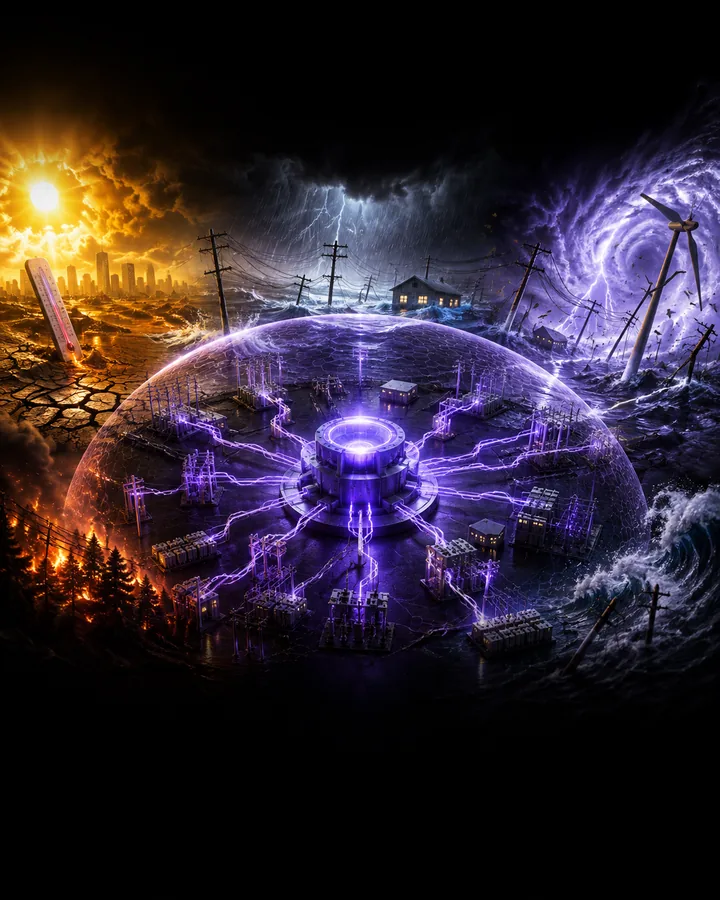
Distribution networks face heat, flood, wind and wildfire hazards that can occur together or in sequence. Measures that help one hazard can leave another exposure unchanged or make restoration harder.
The engineering problem is to compare protection, continuity and recovery strategies without turning literature-informed screening positions into utility measurements or investment approval.
Project objectives
- Compare hardening, elevation, undergrounding, feeder automation, vegetation management, distributed resources, mobile supply, monitoring, spares and critical-load restoration.
- Represent heat, flood, wind, wildfire and compound hazard sequences.
- Separate asset protection, service continuity, restoration speed, operational flexibility, cost, equity and evidence maturity.
- Test balanced, protection, recovery and affordability planning priorities.
- Propagate evidence uncertainty with a fixed random seed.
- Retain hard gates, validation criteria, FMEA cells and assurance requirements alongside weighted scores.
Project structure
Project components
Strategy register
Declares engineering, operational, cost, equity and evidence positions for ten resilience strategies.
Hazard and context model
Crosses five hazards with urban, coastal, forest-interface and rural planning contexts.
Decision model
Compares balanced, asset-protection, service-recovery and affordability priorities using visible weights.
Uncertainty model
Runs 20,000 fixed-seed samples per strategy and retains intervals and threshold probabilities.
Assurance model
Retains validation criteria, workflow FMEA cells, hazard gates and a strategy-to-requirement crosswalk.
Methodology
Project workflow
- 01Define the planning boundary
State hazard horizon, asset scope, critical services, operational limits and decision purpose.
- 02Build compound scenarios
Keep concurrent and sequential hazards, access constraints and cross-infrastructure dependencies visible.
- 03Screen strategies
Apply hazard applicability and hard gates before comparing weighted evidence.
- 04Test priorities and uncertainty
Compare four planning priorities and fixed-seed variation in the declared evidence positions.
- 05Plan utility validation
Convert open gaps into feeder studies, fragility work, field inspection, restoration exercises and current compliance review.
Demonstration scenario
Under balanced weights, ring, mesh, sectionalising and automation leads the retained screening at 78.22, followed closely by critical-load restoration planning, monitoring and distributed resources. The leading strategy changes with the planning priority, showing why resilience requires a portfolio rather than one universal measure.
Engineering
Tools and method
- Tools
- The project uses Python 3.12, NumPy, Pandas, Matplotlib for subject analysis, simulation, and results.
- Engineering model
- Python and NumPy implement the strategy, hazard, context, gate and uncertainty calculations.
- Data analysis
- Pandas retains all 800 cases, summaries, scenarios, FMEA, assurance and sensitivity results.
- Figures
- Matplotlib generates twelve labelled planning, uncertainty and resilience-boundary figures.
- Reproducibility
- A fixed seed, retained configuration, automated tests and Docker reproduce the study.
- Documentation
- The report covers compound hazards, network impacts, adaptation measures, Indian context, methodology, results, limitations and further work.
Testing
Evaluation
Evaluation measures
- Heat, flood, wind, wildfire and compound-event applicability
- Service continuity, restoration speed and operational flexibility
- Critical-load and equity position
- Balanced, protection, recovery and affordability rankings
- Uncertainty intervals and sensitivity to twelve evidence dimensions
- Workflow FMEA priorities, hard gates and assurance completeness
- Exact reproduction of 800 retained cases in a clean Linux container
Project boundaries
- Inputs are literature-informed screening positions and sensitivity cases, not measurements from one utility network.
- Scores are not outage forecasts, fragility curves, switching instructions or investment approvals.
- The project contains no real feeder topology, customer information or critical-infrastructure operating data.
- Costs are relative screening positions and not supplier quotations or project estimates.
- A utility decision requires local hazard layers, asset condition, power-flow and protection studies, customer consequence analysis, current regulation and qualified engineering approval.
Included
- 01Complete reproducible Python source code
- 02Ten distribution-network resilience strategies and five hazard classes
- 03800 deterministic strategy, hazard, context and evidence cases
- 04Four planning scenarios with 20,000 uncertainty samples per strategy
- 05180 workflow FMEA cells and 150 assurance crosswalk cells
- 06Complete CSV, JSON and analytical figure outputs
- 0795-page project documentation in PDF and editable Word formats
- 0816-page setup and usage guide in PDF and editable Word formats
- 0955 annotated references and one sourced literature figure
- 10Automated tests, accessibility audits, repository validation and Docker verification
Project record
No information is collected on this page.
- Permanent project ID
- GP-EE-1MWU0U7
- Catalogued
- 21 Aug 2026
- Completed
- 03 Sept 2026
- Verified
- 03 Sept 2026
- Demonstration
- Included in repository
Handover
After purchase
- 01Payment is confirmed
The project is marked unavailable and cannot be purchased again.
- 02Repository access is granted
The buyer's submitted GitHub account receives access to the private repository.
- 03The purchase record is delivered
The certification sheet is prepared from the reviewed buyer details and sent privately by email.