pandapower distribution-network simulation
A pandapower 3.5.4 study of a synthetic Indian 33/11 kV supply and two radial 11 kV feeders, covering voltage, loading, losses, solar PV, contingencies, and reinforcement.
Software compatibility
The network model, scripts, and reference results use the pinned pandapower 3.5.4 environment. ETAP, DIgSILENT PowerFactory, PSS/E, and PSCAD project files are not included.
Project definition
Problem statement
An 11 kV distribution feeder must keep voltage, conductor loading, transformer loading, and technical losses within planning limits as demand, solar generation, topology, and outages change.
Project objectives
- Build a balanced 33/11 kV source and two radial 11 kV feeders with documented electrical data.
- Verify buses, lines, transformer, switches, loads, and PV aggregations.
- Run present-day, load-growth, solar-PV, daily-profile, outage, restoration, and mitigation cases.
- Measure voltage, loading, losses, reverse power flow, and planning-limit violations.
- Compare tap boost, capacitors, conductor reinforcement, and a combined future-peak solution.
Project structure
Project components
Network builder
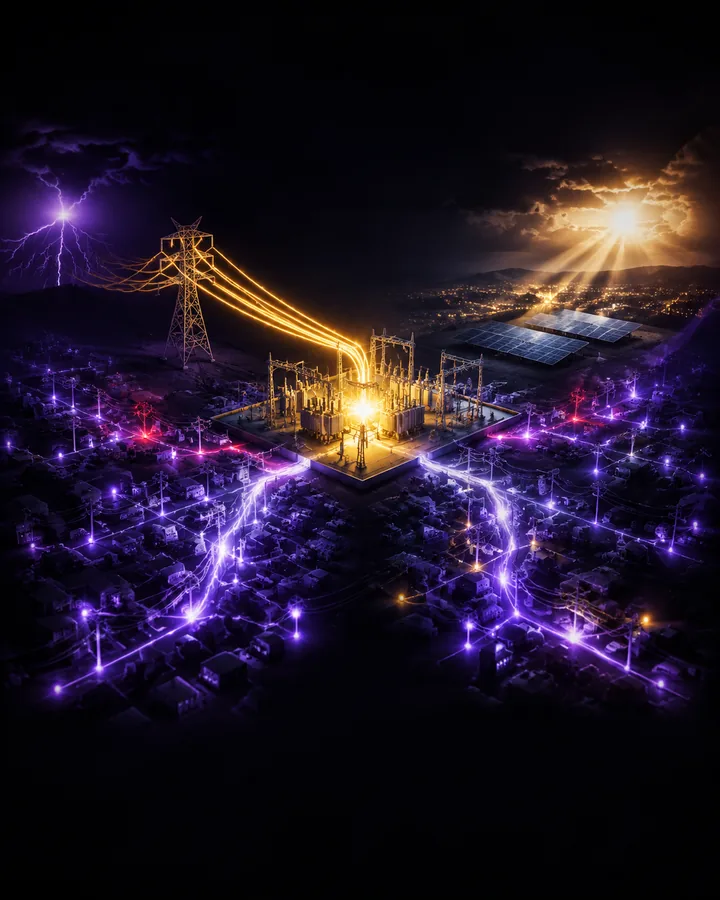
Creates 11 buses, 10 line sections, one transformer, nine loads, five PV aggregations, and a normally open tie.
Power-flow runner
Executes balanced pandapower load flow with convergence, result, and power-balance checks.
Scenario engine
Runs load sweeps, PV sweeps, 96-step daily operation, branch outages, restoration, and mitigation cases.
Result analyser
Calculates minimum voltage, maximum loading, losses, reverse flow, violations, and planning summaries.
Verification suite
Checks the network model, expected engineering trends, result counts, mitigation outcome, and repository completeness.
Methodology
Project workflow
- 01Build
The scripted model creates the feeder, ratings, impedances, loads, generation, and switch topology.
- 02Simulate
The pinned pandapower 3.5.4 environment completes 153 configured study cases.
- 03Analyse
Python consolidates bus, line, transformer, contingency, and time-series results.
- 04Verify
Seven tests check model counts, present operation, future violations, PV behaviour, outage restoration, and mitigation.
- 05Report
Tables and figures present the engineering assumptions, results, limits, and conclusions.
Demonstration scenario
The synthetic feeder passes all present evening-peak checks. At 135 percent demand it fails voltage, loading, and loss limits. A combined tap, capacitor, and conductor-reinforcement case restores compliance while the project separately studies solar reverse flow and outage restoration.
Engineering
Tools and method
- Tools
- The project uses pandapower 3.5.4, Python 3.13, NumPy, Pandas, Matplotlib for subject analysis, simulation, and results.
- Environment
- Pinned Python 3.13 and pandapower 3.5.4 packages in a reproducible Docker image.
- Network model
- Balanced steady-state equivalent circuits represent a synthetic Indian 33/11 kV supply and two 11 kV radial feeders.
- Studies
- Load flow, load and PV sweeps, daily profiles, outage loops, tie restoration, and mitigation comparisons.
- Verification
- Independent radial-feeder calculations, power-balance checks, trend tests, fixed case counts, and automated acceptance limits.
Testing
Evaluation
Evaluation measures
- Present evening-peak minimum voltage of 0.9430 p.u.
- Present maximum line loading of 72.17 percent and transformer loading of 68.76 percent
- Reverse power flow beginning at 1.4 times installed PV during 55 percent load
- First load-growth voltage violation at 110 percent demand
- Restoration of all nine single-branch outages through the normally open tie
- Combined future-peak mitigation improving minimum voltage from 0.9204 to 0.9772 p.u.
Project boundaries
- Only the pinned pandapower 3.5.4 model and result files are delivered.
- The network is synthetic and uses balanced steady-state assumptions for education.
- Protection coordination, electromagnetic transients, grounding, harmonics, and live control are excluded.
- Utility planning and construction require verified asset data, applicable standards, and qualified power-system engineers.
Included
- 01Versioned 11-bus distribution network with two radial feeders
- 02Load-flow, load-growth, solar PV, outage, restoration, and mitigation studies
- 03153 converged study cases and 231 raw result files
- 04Voltage, loading, loss, reverse-flow, contingency, and daily-profile plots
- 05Complete project files, models, calculations, and analysis material in a private GitHub repository
- 0680-page project documentation in PDF and editable Word formats
- 07Setup and usage guide
Project record
No information is collected on this page.
- Permanent project ID
- GP-EE-1WUEPVT
- Catalogued
- 22 Aug 2026
- Completed
- 22 Aug 2026
- Verified
- 22 Aug 2026
- Demonstration
- Included in repository
Handover
After purchase
- 01Payment is confirmed
The project is marked unavailable and cannot be purchased again.
- 02Repository access is granted
The buyer's submitted GitHub account receives access to the private repository.
- 03The purchase record is delivered
The certification sheet is prepared from the reviewed buyer details and sent privately by email.