Vehicle-to-Grid Protection, Battery Degradation and Market-Readiness Study
An electrical engineering study comparing eight vehicle-to-grid architectures across protection, interoperability, battery impact, availability, settlement and market-readiness evidence.
Software compatibility
The retained release and clean Linux container run use Python 3.12. No paid power-system software, charger account or vehicle data is required to reproduce the study.
Project definition
Problem statement
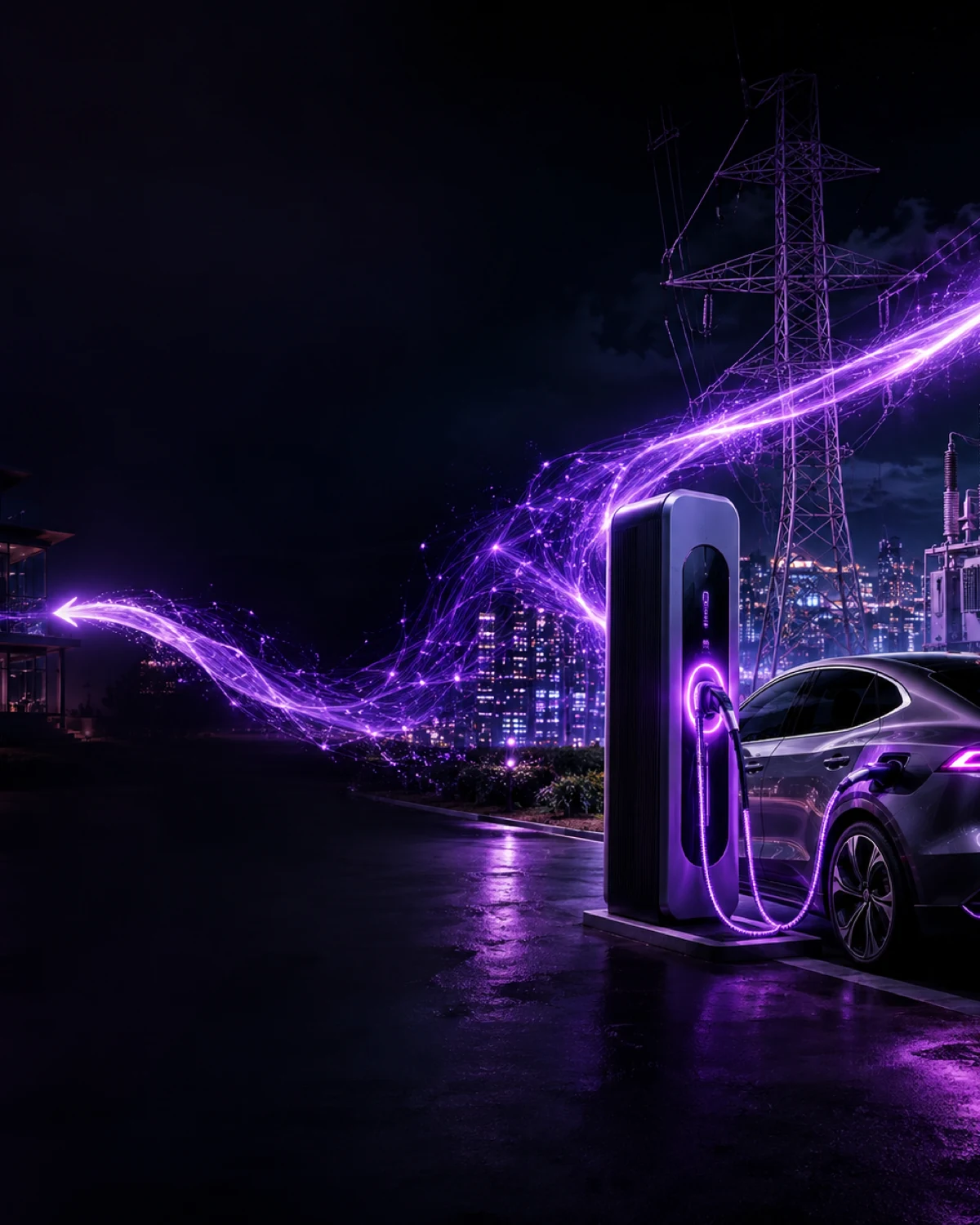
A bidirectional charger can export power, but technical capability does not by itself establish safe interconnection, interoperable control, acceptable battery impact, dependable availability or a settleable market service.
The electrical engineering problem is to compare complete V2G architectures without presenting nominal charger power, one successful pilot or one favourable tariff as universal deployment readiness.
Project objectives
- Compare residential AC and DC V2G, school and transit buses, commercial depots, workplaces, public hubs and resilience-focused V2H or V2B.
- Evaluate protection, anti-islanding, voltage and frequency support, communication interoperability and cybersecurity evidence.
- Keep battery degradation, warranty, mobility reserve and availability limits visible.
- Compare California, United Kingdom, France, Germany, Japan and India market contexts.
- Test balanced, grid-service, battery-protection and market-readiness priorities.
- Retain hard gates, uncertainty, sensitivity, workflow FMEA and an assurance crosswalk.
Project structure
Project components
Architecture register
Declares eight V2G architectures with transparent power, protection, battery, availability and market positions.
Market and system model
Crosses six market contexts with AC, DC, site-controlled and depot-controlled conversion systems.
Decision model
Applies five hard gates and four transparent weighting scenarios to 768 retained cases.
Uncertainty model
Runs 30,000 fixed-seed samples per architecture and retains intervals and threshold results.
Assurance model
Ranks 180 workflow FMEA cells and links architecture evidence to deployment requirements.
Methodology
Project workflow
- 01Define the service boundary
Vehicle, charger, site controller, aggregator, utility, market and mobility-reserve responsibilities are declared.
- 02Build the comparison matrix
Every architecture is evaluated across market, conversion-system and evidence conditions.
- 03Apply decision priorities
Balanced, grid, battery and market scenarios expose conditional rankings.
- 04Propagate uncertainty
Fixed-seed sampling tests whether architecture positions persist when declared evidence varies.
- 05Plan deployment validation
Protection, interoperability, battery, operations and settlement gaps become specific pilot tests.
Demonstration scenario
Under balanced assumptions, school-bus fleet V2G leads the retained comparison because predictable dwell, centralized equipment and planned maintenance improve availability and evidence quality. Public bidirectional fast-charging hubs remain constrained by uncertain dwell, customer mobility, interoperability and settlement readiness despite high nominal power.
Engineering
Tools and method
- Tools
- The project uses Python 3.12, NumPy, Pandas, Matplotlib for subject analysis, simulation, and results.
- Engineering model
- Python and NumPy implement readiness, export-energy, battery-exposure, owner-value and gate calculations.
- Data analysis
- Pandas retains complete case matrices, architecture summaries, scenarios, uncertainty, FMEA and assurance results.
- Figures
- Matplotlib generates twelve labelled architecture, market, battery, uncertainty and risk figures.
- Reproducibility
- A fixed seed, retained configuration, twelve tests and Docker reproduce the study.
- Documentation
- The report covers power flow, protection, communication, cybersecurity, battery ageing, grid services, operations, markets, methods, results and validation.
Testing
Evaluation
Evaluation measures
- Protection conformity, anti-islanding and voltage or frequency support
- Vehicle, charger, aggregator and distribution-system interoperability
- Battery impact evidence, warranty alignment and mobility reserve
- Availability, metering, settlement, market access and owner value
- Balanced, grid-service, battery-protection and market-readiness rankings
- Uncertainty intervals, sensitivity, hard gates, workflow FMEA and assurance completeness
- Exact reproduction of 768 retained cases in a clean Linux container
Project boundaries
- Inputs are literature-informed screening positions, not measurements from one vehicle, charger, feeder or market programme.
- Scores are not grid approvals, relay settings, warranty predictions, tariff offers or investment recommendations.
- Vehicle and charger combinations require multiparty interoperability and current interconnection testing.
- Battery impact depends on chemistry, temperature, state of charge, driving duty, control policy and the counterfactual charging profile.
- A deployment decision requires site power flow, protection coordination, equipment certification, field telemetry, settlement reconciliation and qualified engineering approval.
Included
- 01Complete reproducible Python source code
- 02Eight residential, workplace, public, resilience and fleet V2G architectures
- 03768 deterministic architecture, market, system and evidence cases
- 04Four decision scenarios with 30,000 uncertainty samples per architecture
- 05Five hard gates, fifteen validation criteria and 180 workflow FMEA cells
- 06Complete CSV, JSON and twelve analytical figure outputs
- 0792-page project documentation in PDF and editable Word formats
- 0816-page setup and usage guide in PDF and editable Word formats
- 0972 annotated references and two sourced laboratory images
- 10Twelve automated tests, accessibility audits, repository validation and Docker verification
Project record
No information is collected on this page.
- Permanent project ID
- GP-EE-1NF7MP2
- Catalogued
- 21 Aug 2026
- Completed
- 05 Sept 2026
- Verified
- 05 Sept 2026
- Demonstration
- Included in repository
Handover
After purchase
- 01Payment is confirmed
The project is marked unavailable and cannot be purchased again.
- 02Repository access is granted
The buyer's submitted GitHub account receives access to the private repository.
- 03The purchase record is delivered
The certification sheet is prepared from the reviewed buyer details and sent privately by email.