Inverse heat-conduction regularisation study
An applied-mathematics study that reconstructs transient surface heat flux from noisy internal temperatures using regularised inverse heat conduction.
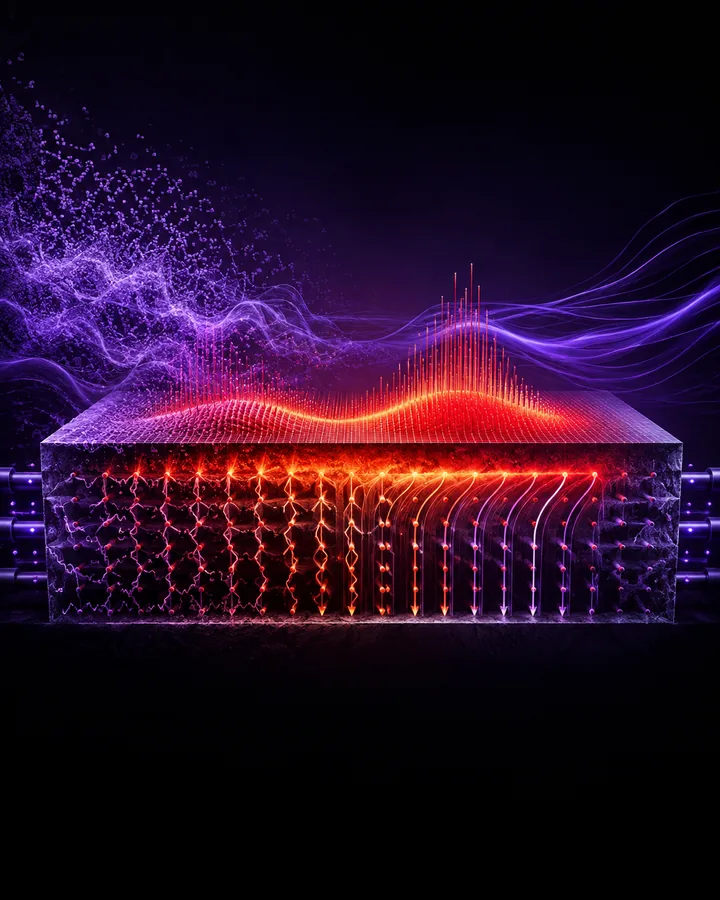
Project definition
Problem statement
Surface heat flux can be difficult to measure directly when the exposed boundary is hot, inaccessible, or disturbed by a sensor.
The mathematical problem is to recover the boundary history from temperatures that have been smoothed by thermal diffusion without amplifying measurement noise into false flux oscillations.
Project objectives
- Model transient one-dimensional conduction through a 12 mm aluminium reference slab.
- Estimate sixty surface-flux intervals from embedded temperature histories.
- Compare three Tikhonov penalty orders and three parameter-selection methods.
- Validate the recovered flux against a sensor depth excluded from estimation.
- Measure the effects of sensor layout, sampling interval, noise, and regularisation across 540 cases.
- Quantify conditional uncertainty with 200 repeated-noise reconstructions.
Project structure
Project components
Thermal model
Builds the 61-node slab operator and exact matrix-exponential state transition.
Inverse solver
Constructs the sensitivity matrix and solves Tikhonov and TSVD reconstructions.
Parameter selection
Evaluates GCV, L-curve curvature, and the Morozov discrepancy principle.
Design experiment
Crosses sensor layout, sampling, noise, penalty order, and selector in 540 cases.
Uncertainty and evidence
Produces Monte Carlo bands, a resolution matrix, CSV evidence, and eight figures.
Methodology
Project workflow
- 01Configure the slab
The study loads the material, grid, boundary, sensor, noise, and inverse settings.
- 02Generate temperatures
A seeded transient flux is propagated to internal sensor depths and perturbed with declared noise.
- 03Recover flux
Nine Tikhonov combinations and a TSVD rank sequence reconstruct the boundary history.
- 04Validate
The recovered flux predicts the independent 6 mm temperature history.
- 05Compare designs
The factorial and Monte Carlo studies quantify accuracy, resolution, and uncertainty.
Demonstration scenario
A multi-feature surface heat flux heats a reference slab for 120 seconds. Temperatures at 2 mm and 10 mm recover the boundary input, while a 6 mm sensor checks the result. The study then compares 540 measurement and regularisation designs.
Engineering
Tools and method
- Tools
- The project uses Python, NumPy, SciPy, Pandas, Matplotlib, Jupyter for subject analysis, simulation, and results.
- Forward mathematics
- Finite-volume spatial discretisation with an exact affine state transition.
- Regularisation
- Weighted least squares with amplitude, slope, or curvature penalties.
- Spectral analysis
- Singular values, TSVD, effective degrees of freedom, and temporal resolution.
- Experiment design
- Five sensor layouts, three sample intervals, four noise levels, three penalties, and three selectors.
- Verification
- Automated tests, coverage, lint, dependency audit, evidence counts, and document validation.
Testing
Evaluation
Evaluation measures
- Surface-flux RMSE and peak error against the known synthetic truth
- Integrated heat-input error and temporal correlation
- Estimation and held-out temperature RMSE
- Second-difference roughness and effective degrees of freedom
- Sensitivity singular spectrum and regularised resolution matrix
- Monte Carlo pointwise uncertainty across 200 reconstructions
Project boundaries
- The temperatures and surface heat flux are deterministic synthetic evidence.
- The model is one dimensional with constant material properties and ideal sensor positions.
- Radiation, contact resistance, lateral loss, sensor lag, and property uncertainty are outside the retained model.
- The project is not a calibration certificate, thermal design approval, or production heat-flux measurement system.
Included
- 01Complete Python source code
- 02Exact matrix-exponential transient heat-conduction model
- 03Zero-, first-, and second-order Tikhonov methods
- 04GCV, L-curve, discrepancy, and TSVD comparisons
- 05540 experimental-design cases and 200 Monte Carlo reconstructions
- 06Eight result figures and complete CSV and JSON evidence
- 0773-page project report in PDF and editable Word formats
- 0815-page setup and usage guide in PDF and editable Word formats
- 0938 annotated references and two sourced literature figures
- 1032 automated tests with 99.37 percent statement coverage
Project record
No information is collected on this page.
- Permanent project ID
- GP-MA-0TR5WSG
- Catalogued
- 21 Aug 2026
- Completed
- 25 Aug 2026
- Verified
- 25 Aug 2026
- Demonstration
- Included in repository
Handover
After purchase
- 01Payment is confirmed
The project is marked unavailable and cannot be purchased again.
- 02Repository access is granted
The buyer's submitted GitHub account receives access to the private repository.
- 03The purchase record is delivered
The certification sheet is prepared from the reviewed buyer details and sent privately by email.