Ti-6Al-4V LPBF process-property optimisation
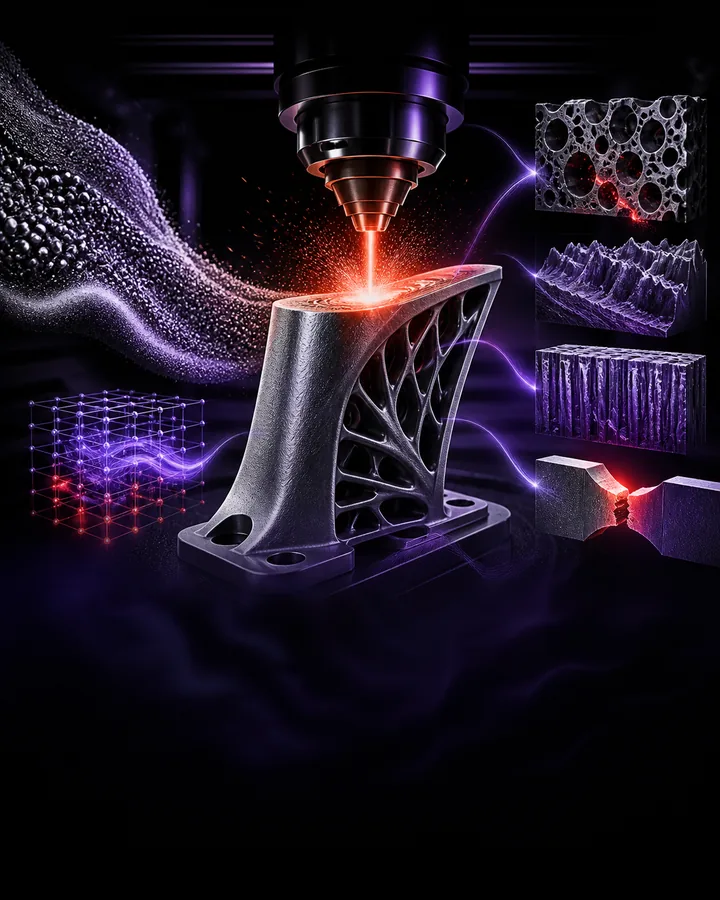
A data-led mechanical and materials study linking Ti-6Al-4V laser powder bed fusion settings to porosity, surface roughness, yield strength, and failure elongation.
Project definition
Problem statement
Laser power and scan speed change melt-pool energy input, but density, surface condition, strength, and ductility do not improve together across every observed setting.
The engineering problem is to compare those competing responses without hiding missing measurements, confusing model estimates with experiments, or presenting an observed optimum as a qualified manufacturing recipe.
Project objectives
- Prepare and quality-check the published 42-setting Ti-6Al-4V process-property dataset.
- Relate laser power, scan speed, and linear energy density to porosity, RMS roughness, yield strength, and failure elongation.
- Compare transparent response models through leave-one-setting-out validation.
- Rank the 35 complete observed cases and identify non-dominated process settings.
- Propagate reported response spread through three thousand seeded decision draws.
Project structure
Project components
Data preparation
Loads the four published workbooks, normalises units and identifiers, and records response availability.
Process-property analysis
Calculates linear energy density and retains descriptive associations between settings and responses.
Model validation
Compares mean, linear, interaction, and quadratic response models using held-out settings.
Decision analysis
Normalises four observed responses, calculates desirability, and identifies the observed Pareto set.
Uncertainty study
Samples reported measurement spread with a fixed seed and measures rank, win, and Pareto stability.
Evidence pipeline
Writes complete CSV, JSON, PNG, SVG, test, document, and container evidence.
Methodology
Project workflow
- 01Load the evidence
The released study reads the compact source workbooks and verifies their expected structure.
- 02Build the feature table
Process settings and measured responses are joined without inventing values for missing tests.
- 03Validate response models
Each candidate model predicts settings excluded from its own fit.
- 04Compare complete cases
The four observed objectives are ranked and checked for Pareto dominance.
- 05Test uncertainty
Seeded response draws quantify whether the leading observed choice remains competitive.
- 06Review the evidence
Retained tables, figures, tests, and limitations connect every headline result to the source data.
Demonstration scenario
Among the 35 complete observed cases, parameter set 41 uses 235 W and 1200 mm/s. It records 0.339 percent porosity, 12.340 micrometre RMS roughness, 1047.8 MPa yield strength, and 15.38 percent failure elongation. It has the highest observed desirability and a 94.4 percent Pareto probability across three thousand seeded uncertainty draws.
Engineering
Tools and method
- Tools
- The project uses Python, NumPy, Pandas, SciPy, scikit-learn, Matplotlib, Jupyter for subject analysis, simulation, and results.
- Published data
- Four CC BY 4.0 Ti-6Al-4V workbooks provide the process, porosity, surface, hardness, tensile, and ductility evidence.
- Numerical analysis
- Python, NumPy, Pandas, SciPy, and scikit-learn implement data preparation, modelling, ranking, and uncertainty calculations.
- Evidence
- CSV, JSON, PNG, SVG, and Matplotlib preserve complete machine-readable and graphical results.
- Verification
- Leave-one-setting-out validation, 42 tests, branch-aware coverage, dependency audit, repository validation, and a pinned Docker workflow.
Testing
Evaluation
Evaluation measures
- Coverage and missingness of the 42 observed parameter settings
- Held-out response-model error across 714 retained predictions
- Porosity, roughness, yield-strength, and elongation tradeoffs
- Observed desirability and Pareto-set membership
- Rank, win, and Pareto stability across three thousand uncertainty draws
- Reproducibility through tests, retained outputs, source checksums, and dependency audit
Project boundaries
- The study analyses one published Ti-6Al-4V experiment and its documented process window.
- Associations and response surfaces are descriptive within the observed data and do not prove a universal causal law.
- The uncertainty model uses reported summary spread and does not reconstruct raw specimen distributions or every systematic error.
- The selected setting is an observed decision-support result, not a qualified machine parameter set, material certificate, or production approval.
Included
- 01Complete Python source code
- 02Four compact published Ti-6Al-4V source workbooks with provenance
- 03Eight complete analysis tables and fifteen analytical figures
- 0476-page project report in PDF and editable Word formats
- 054-page setup and usage guide in PDF and editable Word formats
- 0659 annotated references and four attributed literature images
- 0742 automated tests with 96.56 percent branch-aware coverage
Project record
No information is collected on this page.
- Permanent project ID
- GP-ME-0NND5GR
- Catalogued
- 21 Aug 2026
- Completed
- 27 Aug 2026
- Verified
- 27 Aug 2026
- Demonstration
- Included in repository
Handover
After purchase
- 01Payment is confirmed
The project is marked unavailable and cannot be purchased again.
- 02Repository access is granted
The buyer's submitted GitHub account receives access to the private repository.
- 03The purchase record is delivered
The certification sheet is prepared from the reviewed buyer details and sent privately by email.