CalculiX composite-laminate buckling study
A CalculiX study of stacking sequence, central circular cutouts, mesh refinement, imperfections, elastic buckling, and postbuckling in a thin carbon-epoxy laminate.
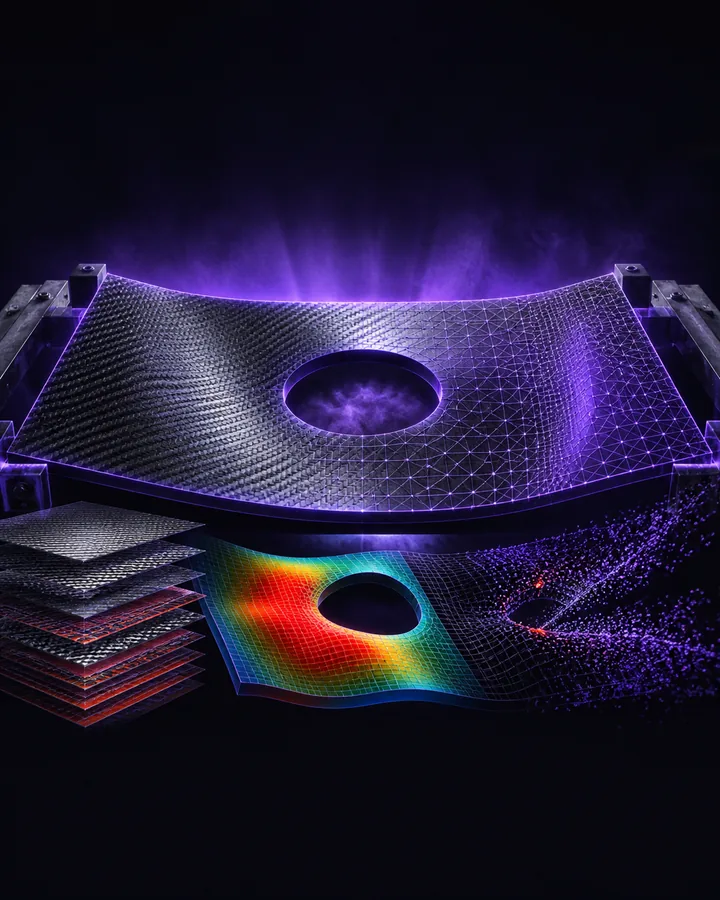
Project definition
Problem statement
Openings interrupt the load path in a thin composite plate, while stacking sequence and ply position change bending stiffness, coupling, and the mode that becomes unstable under compression.
The engineering problem is to separate cutout, laminate, mesh, and imperfection effects while distinguishing first bifurcation from elastic postbuckling and material failure.
Project objectives
- Calculate transformed lamina stiffness and the laminate A, B, and D matrices.
- Compare four symmetric eight-ply stacking sequences with no hole and central circular cutouts.
- Verify specially orthotropic solid plates against an independent classical estimate.
- Measure mesh sensitivity for the quasi-isotropic 30 mm cutout model.
- Compare nonlinear load paths across cutout, layup, and initial-imperfection cases.
Project structure
Project components
Laminate theory
Calculates transformed ply stiffness and the complete laminate A, B, and D matrices.
Geometry and mesh
Builds the plate and true circular cutout with quadratic S6 shell elements.
CalculiX study
Generates and solves linear eigenvalue and geometrically nonlinear composite-shell cases.
Evidence pipeline
Parses DAT and FRD output into histories, surfaces, JSON, CSV, and figures.
Verification suite
Checks theory, load integration, parsers, mesh response, documents, dependencies, and the container workflow.
Methodology
Project workflow
- 01Select a laminate
Choose one of the prepared symmetric stacking sequences.
- 02Generate the plate
Gmsh creates the rectangular surface, circular cutout, node sets, and quadratic mesh.
- 03Solve buckling
CalculiX calculates five linear modes under a distributed 1 N/mm reference compression.
- 04Trace postbuckling
Selected imperfect plates are shortened by 1.5 mm with geometric nonlinearity enabled.
- 05Compare evidence
Critical load, convergence, reaction, transverse response, and mode shape are interpreted together.
Demonstration scenario
The 30 mm quasi-isotropic cutout reaches first Nx 4.417 N/mm at the 8 mm baseline mesh, 0.196 percent above the finest retained result. Its ideal elastic reaction is about 8.436 kN at 1.5 mm shortening.
Engineering
Tools and method
- Tools
- The project uses CalculiX 2.21, Gmsh 4.12, Python, NumPy, Matplotlib, Jupyter for subject analysis, simulation, and results.
- Composite mechanics
- Classical laminate theory with explicit bending-twisting coupling and declared limits.
- Finite elements
- CalculiX S6 composite shells with eight physical plies and true cutout geometry.
- Automation
- Python, NumPy, and Matplotlib for deterministic cases, parsing, results, and figures.
- Reproducibility
- Digest-pinned Ubuntu container running CalculiX and Gmsh as an unprivileged user.
Testing
Evaluation
Evaluation measures
- First eigenvalue buckling Nx and critical load
- Specially orthotropic classical-theory difference
- Residual mesh sensitivity from 12 to 6 mm
- Reaction against applied end shortening
- Monitored and full-field transverse displacement
- Automated tests, dependency audit, and delivery validation
Project boundaries
- The lamina properties are representative and are not measured material allowables.
- The model is geometrically nonlinear but materially linear elastic.
- Progressive ply damage, delamination, fixture compliance, and measured imperfections are not included.
- Results are computational comparisons, not strength, certification, or physical validation.
Included
- 01Complete Python and CalculiX source code
- 02Sixteen linear and six geometrically nonlinear cases
- 03JSON and CSV results with nine project figures
- 0478-page project report in PDF and editable Word formats
- 0513-page setup and usage guide in PDF and editable Word formats
- 0630 annotated references and two attributed literature images
- 0720 automated tests and a pinned Docker workflow
Project record
No information is collected on this page.
- Permanent project ID
- GP-ME-09ZH8JM
- Catalogued
- 21 Aug 2026
- Completed
- 25 Aug 2026
- Verified
- 25 Aug 2026
- Demonstration
- Included in repository
Handover
After purchase
- 01Payment is confirmed
The project is marked unavailable and cannot be purchased again.
- 02Repository access is granted
The buyer's submitted GitHub account receives access to the private repository.
- 03The purchase record is delivered
The certification sheet is prepared from the reviewed buyer details and sent privately by email.