Hydrogen Embrittlement Material Selection for Storage and Transport Systems
An evidence-led mechanical and materials engineering study comparing eight candidate materials and systems for gaseous-hydrogen pipelines and stationary storage.
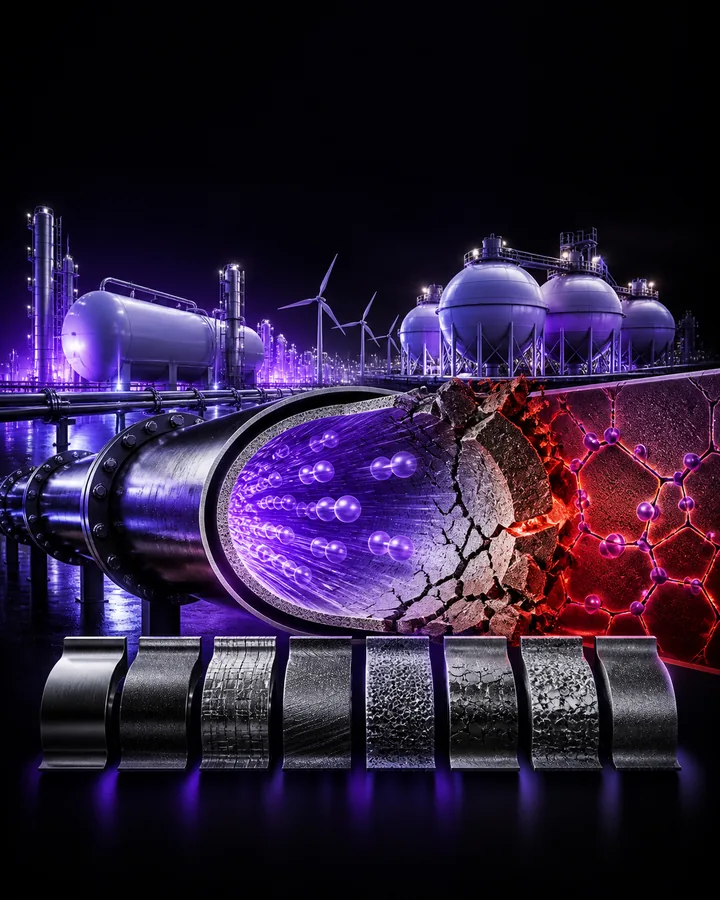
Project definition
Problem statement
Hydrogen can reduce ductility and fatigue resistance in metallic pressure systems, while pipelines, vessels, welds, pressure cycles, inspection access, cost, and code readiness impose different selection constraints.
The engineering problem is to screen plausible material and system families without turning limited literature evidence into an unsupported universal material recommendation.
Project objectives
- Build a screened and annotated evidence base for eight candidate material and system families.
- Define four gaseous-hydrogen pipeline and stationary-storage service cases from 10 to 90 MPa.
- Apply safety gates before calculating any comparative ranking.
- Compare candidates across nine evidence criteria with deterministic and uncertainty analysis.
- Test pressure, cycle severity, weld penalty, and cost-weight sensitivity and define mandatory qualification work.
Project structure
Project components
Evidence matrix
Records criterion scores, annotations, source links, and declared evidence boundaries for every candidate.
Safety gates
Excludes candidates that do not satisfy scenario-specific compatibility, fabrication, inspection, and pressure-system requirements.
Decision model
Ranks only candidates that pass the gates using nine declared criteria and scenario-specific weights.
Uncertainty analysis
Runs 25,000 seeded samples per service case to measure rank and leadership stability.
Sensitivity analysis
Challenges the result through pressure, cycling, weld, and cost-weight variations.
Qualification map
Connects each retained option to required material, weld, component, inspection, and code-review work.
Methodology
Project workflow
- 01Define the service case
Pressure, duty, cycling, fabrication, inspection, and cost conditions are fixed before selection.
- 02Review the evidence
Candidate evidence positions and limitations are traced to the screened source matrix.
- 03Apply the gates
Safety and feasibility requirements are evaluated before comparative scores are used.
- 04Rank retained options
Scenario weights produce a transparent deterministic comparison among gate-passing candidates.
- 05Challenge the ranking
Seeded uncertainty and four sensitivity studies test whether the leading choice remains stable.
- 06Plan qualification
The final map states what must still be tested and reviewed before engineering use.
Demonstration scenario
For the released screening assumptions, X52 leads the 10 MPa pipeline case, while 316L leads the 30 MPa pipeline and the 45 MPa and 90 MPa stationary-storage cases. These are evidence-led screening results, not qualified designs or code approvals.
Engineering
Tools and method
- Tools
- The project uses Python, NumPy, Pandas, Matplotlib, Jupyter for subject analysis, simulation, and results.
- Evidence synthesis
- Sixty screened references support an annotated material, service, degradation, fabrication, and standards matrix.
- Selection method
- Safety gates precede a weighted nine-criterion comparison for four declared service cases.
- Numerical analysis
- Python, NumPy, and Pandas implement deterministic ranking, 100,000 total uncertainty samples, and sensitivity studies.
- Evidence output
- CSV, JSON, PNG, and Matplotlib retain every score, gate, ranking, interval, sensitivity, and testing requirement.
- Verification
- Automated tests, repository validation, document audits, and a pinned Docker run verify reproducibility.
Testing
Evaluation
Evaluation measures
- Safety-gate outcome for each candidate and service case
- Deterministic score and rank among retained candidates
- First-rank share and score interval across uncertainty samples
- Response to pressure and cycle-severity changes
- Response to weld penalties and cost-weight changes
- Completeness of the mandatory material, weld, component, inspection, and code checks
Project boundaries
- Scores from one to five are ordinal evidence-synthesis positions, not measured properties or code allowables.
- The uncertainty analysis describes nearby model inputs and does not calculate failure probability.
- The four service cases are screening scenarios and are not pressure-system designs.
- Product-specific hydrogen testing, representative weld qualification, inspection validation, component testing, and current code review remain mandatory.
- The project does not qualify a material, weld, component, vessel, or pipeline.
Included
- 01Complete Python source code
- 02Eight candidate materials and systems across four service cases
- 03Nine evidence criteria with safety gates and mandatory testing maps
- 0425,000 uncertainty samples for each service case
- 05Nine CSV tables, one JSON summary, and fourteen labelled figures
- 0698-page project report in PDF and editable Word formats
- 0718-page setup and usage guide in PDF and editable Word formats
- 0860 screened and annotated references with a source matrix
- 09Six automated tests, repository validation, and a Docker workflow
Project record
No information is collected on this page.
- Permanent project ID
- GP-ME-01Y3O9B
- Catalogued
- 21 Aug 2026
- Completed
- 29 Aug 2026
- Verified
- 29 Aug 2026
- Demonstration
- Included in repository
Handover
After purchase
- 01Payment is confirmed
The project is marked unavailable and cannot be purchased again.
- 02Repository access is granted
The buyer's submitted GitHub account receives access to the private repository.
- 03The purchase record is delivered
The certification sheet is prepared from the reviewed buyer details and sent privately by email.