ROSS rotordynamic critical-speed study
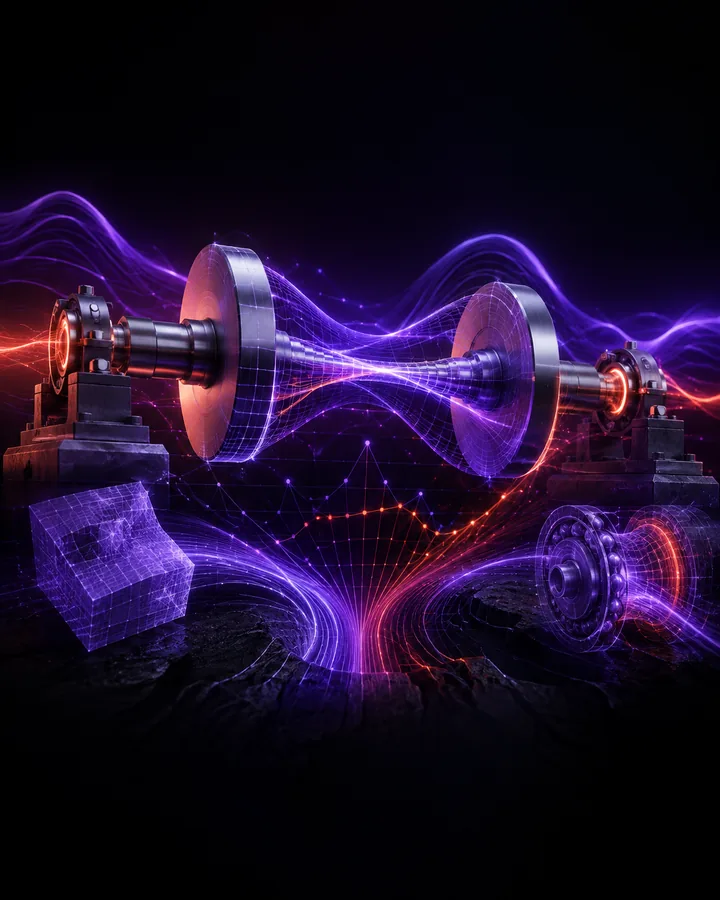
A ROSS finite-element study of critical speeds, Campbell branches, synchronous unbalance response, bearing sensitivity, mesh convergence, stability, and uncertainty for a two-disk flexible rotor.
Project definition
Problem statement
A flexible rotor can cross bending resonances, respond strongly to residual unbalance, or become unstable through support cross-coupling even when its static design appears satisfactory.
The engineering problem is to connect the rotor model, Campbell intersections, forced response, bearing behavior, mesh resolution, stability, and parameter uncertainty in one traceable study.
Project objectives
- Build a 1.2 m steel shaft with twelve Timoshenko elements, two rigid disks, and two anisotropic bearings.
- Calculate speed-dependent modes, damped critical speeds, logarithmic decrement, unbalance response, and disk orbit.
- Measure sensitivity to direct bearing stiffness and damping.
- Verify the first modes across six, twelve, and twenty-four shaft elements.
- Map cross-coupled instability and propagate sixty seeded parameter combinations.
Project structure
Project components
Rotor model
Validates the configuration and assembles ROSS shaft, disk, and bearing elements.
Modal analysis
Calculates speed-dependent whirl branches, damping, and critical-speed intersections.
Forced response
Applies a declared 20 g mm unbalance and retains amplitudes, peaks, and disk orbit.
Sensitivity studies
Varies direct bearing stiffness, damping, mesh count, and parameter uncertainty.
Stability study
Maps minimum logarithmic decrement against speed and imposed cross-coupled stiffness.
Evidence pipeline
Writes complete CSV, JSON, NPZ, figure, test, and document evidence.
Methodology
Project workflow
- 01Build the rotor
The shaft, two disks, and two end bearings are assembled from the released SI-unit configuration.
- 02Solve the modes
ROSS calculates damped modes and one-times critical-speed intersections from 0 to 12000 rpm.
- 03Apply unbalance
A synchronous rotating force is applied at the second disk across the complete speed sweep.
- 04Test the model
Support, mesh, stability, and uncertainty experiments challenge the baseline assumptions.
- 05Review the evidence
Tables, figures, tests, and independent checks are interpreted with the declared validity boundary.
Demonstration scenario
The released rotor has first damped critical speeds of 1506.26 and 1575.18 rpm. A 20 g mm unbalance produces a 10.745 micrometre maximum at 1558.50 rpm, while sixty uncertainty cases place the first mode between 1405.41 and 1589.70 rpm.
Engineering
Tools and method
- Tools
- The project uses Python, ROSS 2.3.0, NumPy, SciPy, Pandas, Matplotlib, Jupyter for subject analysis, simulation, and results.
- Finite elements
- ROSS 2.3.0 Timoshenko shaft elements with rigid disks, gyroscopic action, and linear bearings.
- Numerical analysis
- NumPy and SciPy support controlled sweeps, peak calculations, and retained arrays.
- Evidence
- Pandas, JSON, NPZ, and Matplotlib provide complete machine-readable and graphical results.
- Verification
- Mesh refinement, independent trend checks, 64 tests, full core branch coverage, and dependency audit.
Testing
Evaluation
Evaluation measures
- Damped critical-speed locations and whirl direction
- Synchronous response peak and disk orbit
- Rated-speed separation from critical-speed regions
- Bearing stiffness and damping sensitivity
- Residual mesh error from twelve to twenty-four elements
- Cross-coupled stability boundary and sixty-case uncertainty range
Project boundaries
- The dimensions, disk properties, bearing coefficients, and uncertainty bounds are illustrative and do not describe a named machine.
- The model uses linear bearings and does not include seals, foundation flexibility, nonlinear contact, rub, cracks, thermal bow, torsion, shaft stress, or fatigue.
- The stability sweep uses imposed cross-coupled stiffness and is not a measured seal or fluid-film bearing model.
- Results support learning and comparative analysis, not balancing acceptance, machinery certification, or permission to operate rotating hardware.
Included
- 01Complete Python and ROSS source code
- 02Modal, critical-speed, unbalance, bearing, mesh, stability, and uncertainty studies
- 03Nine complete analysis tables, one NPZ archive, and fourteen project figures
- 0471-page project report in PDF and editable Word formats
- 0517-page setup and usage guide in PDF and editable Word formats
- 0650 annotated references and three attributed literature images
- 0764 automated tests with 100 percent branch-aware core coverage
Project record
No information is collected on this page.
- Permanent project ID
- GP-ME-0F545PA
- Catalogued
- 21 Aug 2026
- Completed
- 26 Aug 2026
- Verified
- 26 Aug 2026
- Demonstration
- Included in repository
Handover
After purchase
- 01Payment is confirmed
The project is marked unavailable and cannot be purchased again.
- 02Repository access is granted
The buyer's submitted GitHub account receives access to the private repository.
- 03The purchase record is delivered
The certification sheet is prepared from the reviewed buyer details and sent privately by email.