MEEP photonic-crystal cavity study
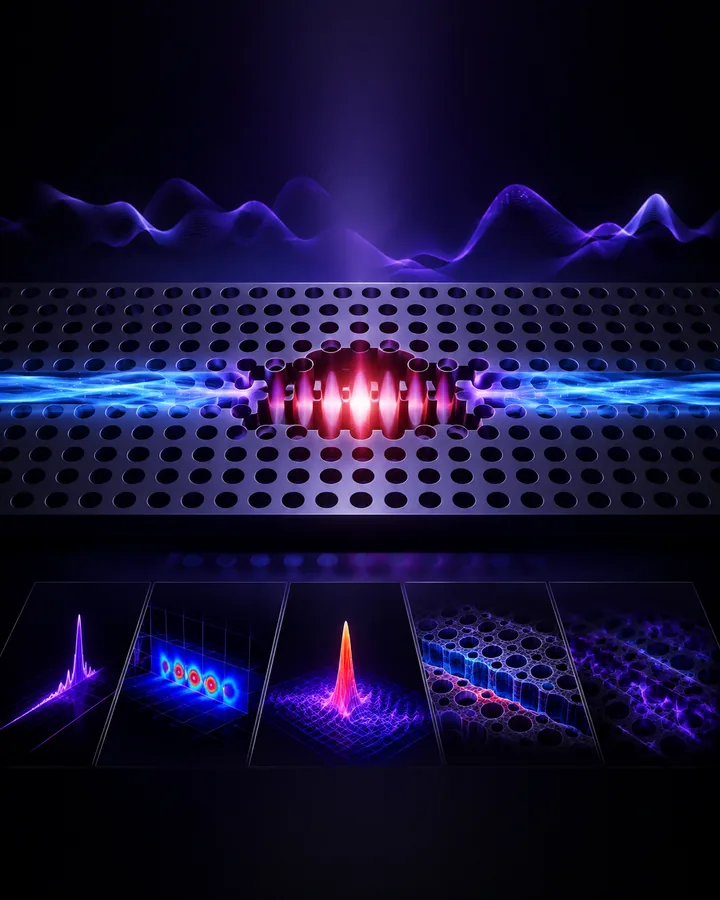
A completed MEEP study of a two-dimensional photonic-crystal waveguide cavity covering resonance, transmission, confinement, geometry sensitivity, numerical convergence, and radius disorder.
Software compatibility
The source, retained fields, spectra, and reference results use the pinned MEEP 1.34.0 conda-forge environment. COMSOL, Lumerical FDTD, CST, and MATLAB project files are not included.
Project definition
Problem statement
A photonic-crystal cavity cannot be evaluated from one quality-factor value. Resonant frequency, field localization, spectral coupling, numerical convergence, and geometry sensitivity must support the same physical interpretation.
The physics problem is to reproduce a documented defect cavity and separate meaningful electromagnetic trends from finite-resolution, finite-domain, finite-runtime, and mode-selection effects.
Project objectives
- Reproduce a holey dielectric waveguide cavity with a central spacing defect.
- Extract resonant frequency, decay, quality factor, field confinement, and effective mode area.
- Normalize cavity and periodic-mirror transmission against an empty waveguide.
- Measure the effects of mirror count, defect spacing, hole radius, resolution, and transverse size.
- Run a deterministic five-seed radius-disorder experiment.
Project structure
Project components
Geometry model
Builds the dielectric waveguide, periodic holes, central defect, symmetries, finite cell, and absorbing boundaries.
Resonance solver
Excites the cavity, performs harmonic inversion, selects the target branch, and retains field evidence.
Transmission solver
Calculates empty-waveguide, periodic-mirror, and defect-cavity flux on one 600-point frequency grid.
Parameter study
Runs mirror, spacing, radius, resolution, domain, and seeded-disorder comparisons around one baseline.
Evidence
Retains CSV, JSON, compressed field arrays, eight labelled figures, tests, and complete documentation.
Methodology
Project workflow
- 01Load a case
A validated immutable case declares the geometry, numerical resolution, domain, and disorder seed.
- 02Run MEEP
The FDTD solver excites the structure and records temporal or spectral response.
- 03Extract the mode
Harminv estimates complex frequency and the solver calculates field localization measures.
- 04Compare cases
Retained tables and figures expose geometry, leakage, convergence, and disorder trends.
- 05Verify
Exact MEEP integration tests, coverage, dependency audit, and repository checks confirm the release.
Demonstration scenario
The baseline six-period cavity produces a resonance at 0.234541477 c/a with Q 5748.1 and defect confinement 0.658. A separate three-period transmission calculation peaks at 0.234474124 c/a, close to the independent Harminv value of 0.234454153 c/a. The student then explains why the spacing 1.5a case reaches higher Q and why absolute Q remains more numerically sensitive than frequency.
Engineering
Tools and method
- Tools
- The project uses MEEP 1.34.0, Python 3.11, NumPy, Pandas, SciPy, Matplotlib for subject analysis, simulation, and results.
- Electromagnetic solver
- MEEP 1.34.0 advances the two-dimensional FDTD model in normalized lattice units.
- Experiment control
- Python validates 27 unique resonance cases and three normalized transmission runs.
- Evidence storage
- NumPy, CSV, and JSON retain field arrays, spectra, metrics, and principal outcomes.
- Analysis
- Pandas and Matplotlib generate eight report figures from retained evidence.
- Verification
- Twenty-one tests cover configuration, geometry, mode selection, field metrics, MEEP resonance, and MEEP flux operation.
Testing
Evaluation
Evaluation measures
- Resonant frequency and quality factor
- Defect confinement and effective mode area
- Normalized transmission peak and finite mirror stop band
- Mirror-period, defect-spacing, and hole-radius sensitivity
- Resolution and transverse-domain response
- Frequency and Q variation under seeded radius disorder
Project boundaries
- Only the pinned MEEP 1.34.0 environment and open result formats are delivered.
- The model is two dimensional, scale invariant, linear, non-dispersive, and lossless inside the dielectric.
- Effective mode area is not presented as a three-dimensional physical mode volume.
- The results do not specify a material platform, physical wavelength, slab thickness, fabrication tolerance, or measured device.
- Physical implementation requires a three-dimensional material-specific study and experimental validation.
Included
- 01Complete Python and MEEP source code
- 02Twenty-seven completed resonance cases and three transmission runs
- 03Twenty-seven compressed dielectric and field-intensity arrays
- 04Six-hundred-point normalized transmission spectrum
- 05Eight labelled result figures
- 06Twenty-one automated tests with 100 percent combined coverage
- 07Complete project files, calculations, results, and analysis material in a private GitHub repository
- 08108-page project documentation in PDF and editable Word formats
- 0921-page setup and usage guide in PDF and editable Word formats
- 10Forty-five annotated references
Project record
No information is collected on this page.
- Permanent project ID
- GP-PH-0W8JQWH
- Catalogued
- 21 Aug 2026
- Completed
- 24 Aug 2026
- Verified
- 24 Aug 2026
- Demonstration
- Included in repository
Handover
After purchase
- 01Payment is confirmed
The project is marked unavailable and cannot be purchased again.
- 02Repository access is granted
The buyer's submitted GitHub account receives access to the private repository.
- 03The purchase record is delivered
The certification sheet is prepared from the reviewed buyer details and sent privately by email.