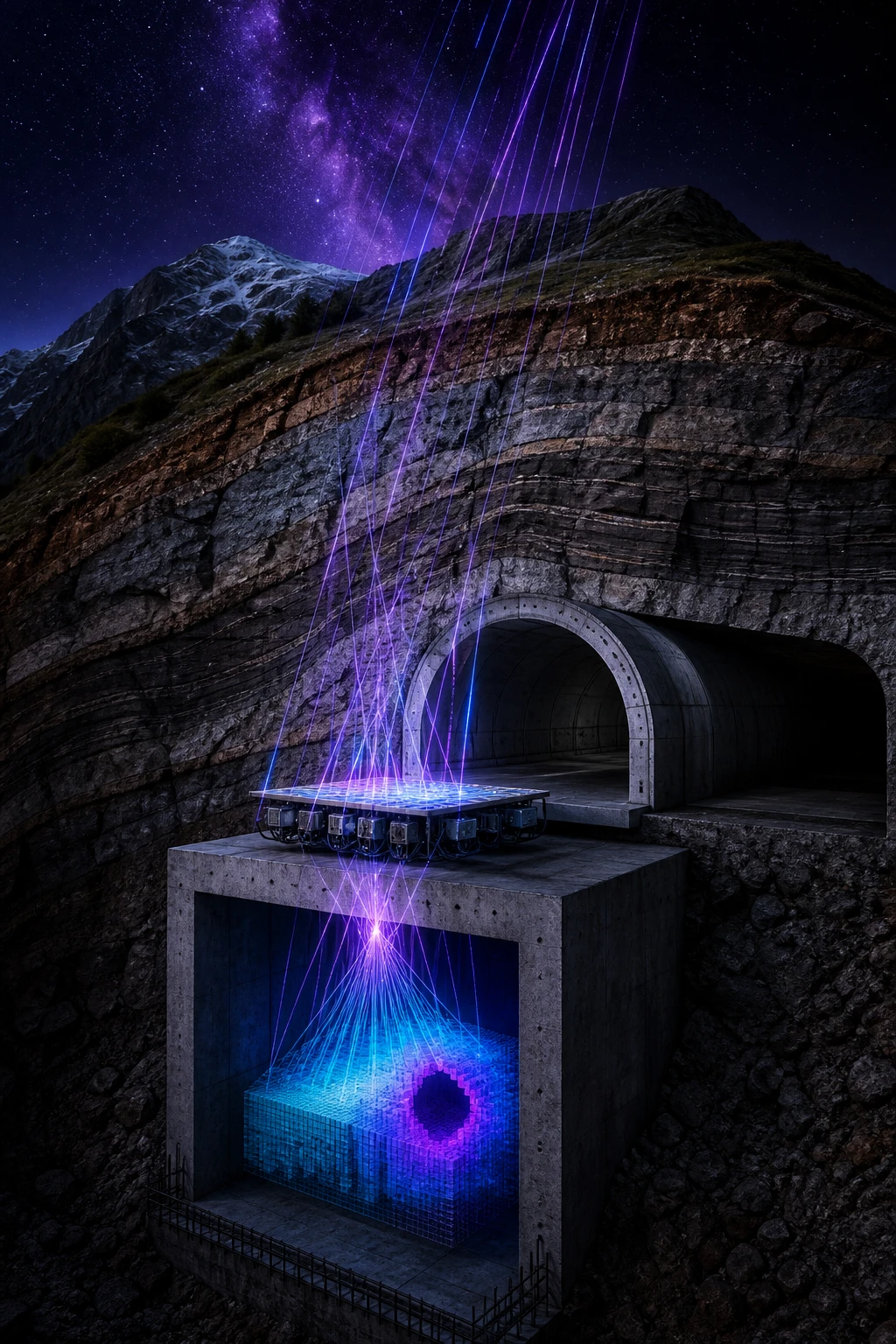
Muon Tomography for Structural and Geological Inspection
A completed physics study comparing eight cosmic-ray muon-imaging system archetypes for structural, geological and shielded-object inspection.
Software compatibility
The released results use the frozen 4 September 2026 evidence catalogue, pinned Python packages, 20,000 uncertainty draws per system and random seed 20260904. Site-specific use requires measured detector and survey data.
Project definition
Problem statement
Muon imaging performance cannot be judged from detector area or exposure time alone. Particle flux, material thickness, geometry, angular resolution, background, calibration and reconstruction all affect what can be resolved.
The physics problem is to compare transmission and scattering system archetypes without turning literature evidence positions into unsupported site-specific detection claims.
Project objectives
- Compare eight detector-system archetypes across six structural, geological and shielded-object targets.
- Separate transmission attenuation from multiple Coulomb scattering applications.
- Evaluate four deployment contexts and four evidence cases through one consistent framework.
- Map detector, geometry, exposure, reconstruction and validation limitations.
- Test decision stability through scenario, sensitivity and fixed-seed uncertainty analysis.
- Retain complete results, figures, tests, references and editable documentation.
Project structure
Project components
System register
Defines eight transmission and scattering detector archetypes with declared performance and evidence positions.
Target model
Represents geological overburden, tunnels, concrete structures, industrial vessels, cargo and shielded dense objects.
Comparison engine
Calculates screening, evidence and gate outcomes for 768 system, target, context and evidence combinations.
Decision analysis
Compares balanced, geological, civil and assurance priorities and tests sensitivity to evidence positions.
Validation planning
Uses fifteen criteria, workflow FMEA and an assurance crosswalk to define the work required before field claims.
Evidence package
Retains CSV, JSON, PNG, Word, PDF, references, tests and Docker reproduction.
Methodology
Project workflow
- 01Define the inspection question
Specify the target, density contrast, geometry, access, decision threshold and permitted conclusion.
- 02Select the imaging mode
Choose transmission or scattering according to thickness, target scale and detector placement.
- 03Plan the measurement
Declare acceptance, exposure, angular coverage, calibration, background and environmental controls.
- 04Reconstruct and compare
Process retained evidence while tracking resolution, artefacts, uncertainty and alternative explanations.
- 05Validate the claim
Use reference targets, blind cases, repeat measurements and qualified domain review before operational use.
Demonstration scenario
The completed study compares a tunnel and rock-overburden inspection across transmission detector systems, then contrasts that decision with a dense shielded-object case suited to scattering tomography. The retained scenarios show why the preferred system changes when geometry, exposure, access or assurance priorities change.
Engineering
Tools and method
- Tools
- The project uses Python 3.12, NumPy, pandas, Matplotlib for subject analysis, simulation, and results.
- Declared inputs
- Python data structures retain every detector, target, context and evidence position.
- Deterministic analysis
- NumPy and pandas generate all 768 comparison cases and four decision scenarios.
- Risk analysis
- Validation criteria, workflow FMEA and assurance links expose the highest-priority evidence gaps.
- Uncertainty
- Fixed-seed Monte Carlo and one-factor sensitivity test whether the comparative ranking is stable.
- Reporting
- Matplotlib, CSV, JSON, Word and PDF retain the method, results and evidence boundaries.
- Verification
- Tests, linting, vulnerability audit, document QA, repository validation and Docker verify the handover.
Testing
Evaluation
Evaluation measures
- Screening and evidence scores by detector, target and deployment context
- Transmission and scattering suitability for each inspection target
- Gate-pass rate and severity-weighted validation gaps
- Balanced, geological, civil and assurance scenario rankings
- Workflow FMEA priorities and assurance coverage
- Monte Carlo intervals and evidence-position sensitivity
Project boundaries
- All zero-to-ten inputs are literature-informed positions rather than measurements from one controlled detector campaign.
- The study does not claim a site-specific detection limit, spatial resolution, exposure duration or probability of detection.
- It does not provide radiological clearance, structural certification, geological interpretation or procurement advice.
- The comparison does not replace raw counts, detector-response calibration, background treatment or reconstruction validation.
- A real survey requires measured geometry, calibration, reference targets, uncertainty and qualified domain review.
Included
- 01Complete Python source and declared study configuration
- 02Eight detector-system archetypes and six inspection targets
- 03768 system, target, context and evidence cases
- 04Four decision scenarios and 20,000 fixed-seed uncertainty draws per system
- 05Fifteen validation criteria, 180 workflow FMEA cells and 120 assurance links
- 06Twelve generated figures and complete CSV result tables
- 07101-page project report in PDF and editable Word formats
- 0816-page setup and usage guide in PDF and editable Word formats
- 09Sixty annotated references and one attributed literature photograph
- 10Automated tests, repository validation and Docker reproduction
Project record
No information is collected on this page.
- Permanent project ID
- GP-PH-08YF9SP
- Catalogued
- 21 Aug 2026
- Completed
- 04 Sept 2026
- Verified
- 04 Sept 2026
- Demonstration
- Included in repository
Handover
After purchase
- 01Payment is confirmed
The project is marked unavailable and cannot be purchased again.
- 02Repository access is granted
The buyer's submitted GitHub account receives access to the private repository.
- 03The purchase record is delivered
The certification sheet is prepared from the reviewed buyer details and sent privately by email.